The Moon in the Fitted Sheet
Page 279 of 303
Chapters
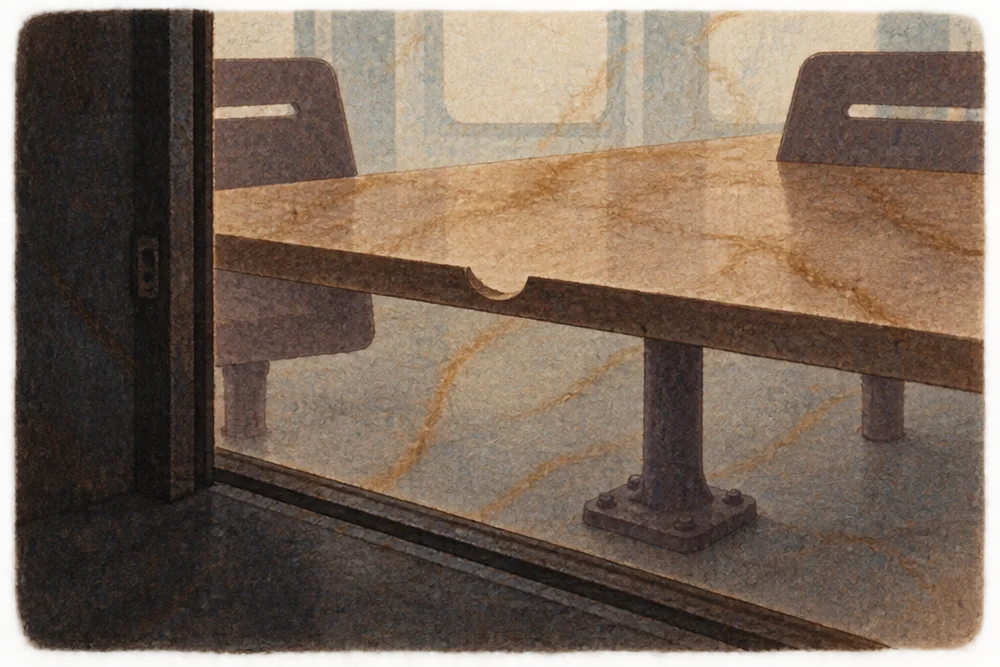
They sent the first group through the radial passage with sealed bins clipped between them. The route curved past the laundry shaft, where the linen loop had been locked down after the release. There was no more municipal cycle to tumble sheets into their old folds; the machinery hung silent behind its panel, a dark circle in the wall. Elva moved at the back of the group. She kept one hand on the rail and the other near the shoulder of the child’s father, who was towing a bin with his belt tether. The child held the opposite line with both hands. They floated in a careful chain, not quite walking, not quite swimming. Every few meters, someone called the next handhold by its painted number. At the junction, an elderly resident stopped. He had a cloth cap tied beneath his chin and a small tin cup clipped to his sleeve. He stared at the open hatch leading toward the old dining deck. “My table’s still there,” he said. “The one with the dent.” It was an ordinary table, bolted through its legs to the deck. Elva could see the lip of its surface beyond the hatch, a brown rectangle cut by a crescent-shaped dent. The old room had been arranged around it, chairs facing chairs, plates set with their bottoms resting on the tabletop. Everything was still secured, but the place no longer meant what it had meant yesterday. “We can bring it to the ring later,” Elva said. “If it can be unbolted.” The man looked at her. “Later, then.” They continued. At the ring entrance, Hesta waited beside a pressure door with her chin forward and her long hands braced around a handhold. She had joined the ward transfer team rather than rest. Elva tried not to look at the tremor in her arms. “Is the meal safe?” Hesta asked. “Sealed and dry.” “Good. Bring it in on the wall side. We’ve marked the serving rail.” The ring’s interior smelled of metal, antiseptic, and the tomato broth they had warmed in its sealed recirculation unit. Here, pumps worked because the system had been rebuilt to circulate water without relying on down. A row of patients watched from tethered chairs. One man had a small fan clipped to his chest; its stream of air stirred the fringe of a blanket. Oren appeared from the ward’s service hatch, still in his charcoal tabard. “This is a stopgap,” he said. Elva clipped the first bin to the serving rail. “It’s a meal.”