The Moon in the Fitted Sheet
Page 27 of 303
Chapters
“He knew about the moon.”
“He knew there was something. I thought it was an old maintenance superstition.” Linio looked at her, and guilt softened his mouth. “I’m sorry.”
Elva wanted to tell him that he had not made the fold, that no one had told her, that an apology did not bring the orchard closer. Instead she asked, “What happens if I leave it braced?”
“Nothing stays safe forever. The sheet could shift. The station’s gravity could tilt. The fabric could tear.” He paused. “But I can keep it out of the wash while we find out what we’re dealing with.”
“We?”
“You brought me a moon.” Linio gave a small, humorless smile. “I’m not sending you back upstairs with it and a strap.”
Elva wondered whether he was being kind or simply unwilling to let a fault go unlogged. It did not matter. The sheet had been braced through the night with her hands and improvised straps. She could not hold it alone for another day, and she could not carry it back up the transit shaft without help.
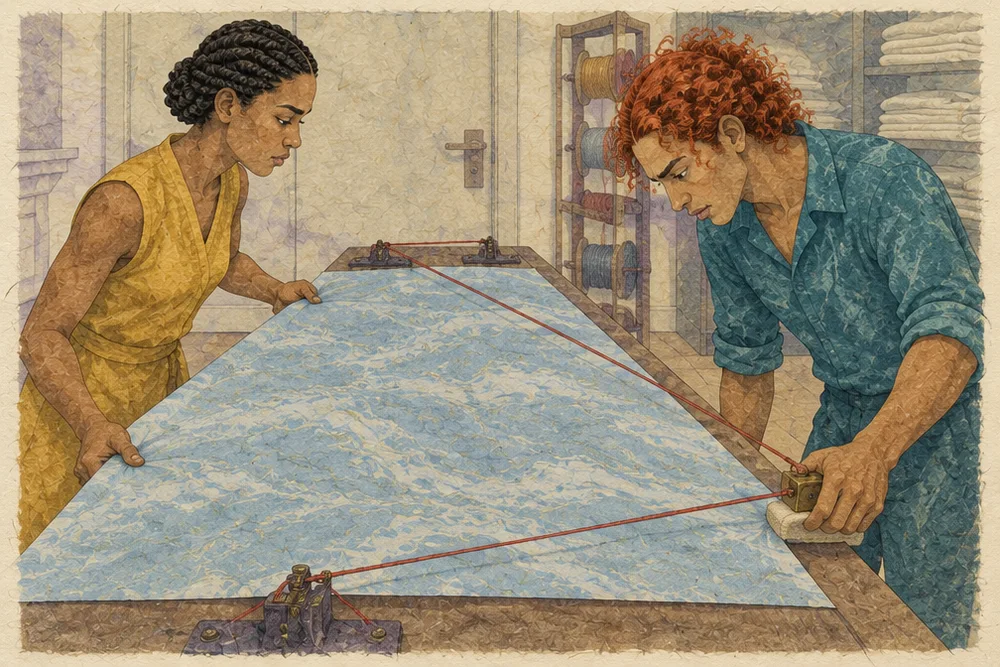
Linio went to the door and checked the corridor before opening it a crack. He spoke to the clerk outside, asking for the counter to mark her linen as held for inspection. The clerk’s reply was a question. Linio answered in the dry tone of procedure: “Unusual seam. Manual review.”
When he returned, he brought a thin red cord from the spool rack and a pair of soft clamps. He fixed the sheet to the table at intervals, careful not to pinch the bulge beneath. Elva held the opposite edges taut. The cord ran across the worktable in a crossed pattern, each line secured to a metal bracket.
“If this is part of a larger system,” he said, “we need to know which corner is loose and what the neighboring seams are doing. We should not try to make it smaller. We should not expose more of it. And we should not put it near any laundry machinery.”
“You said light can cross. Could we use that to see more?”
“Maybe.” He looked toward the ceiling as if estimating the position of the light panels above them. “But not without finding a way to control the opening. The right angle matters. Touch requires alignment; the light may be less fussy, but I’ve never tested it.”
“My light reached them.”
“Your apartment night light?”