The Moon in the Fitted Sheet
Page 215 of 303
Chapters
Oren looked down the line. “Ward transfer complete. Ring remains stable.” That was not one of the three calls, but Elva was glad to hear it. They had worked too hard to make the ward an afterthought.
At the signal, the crew took up the fabric. It moved hand to hand with a soft rasp. Elva felt the strain arrive in her section a fraction before she saw the next volunteer’s shoulders set. The blue mark slid past the floor bracket. The seam at the rail rotated, then the next, the linen making a slow, controlled spiral.
Then it stopped.
The resistance was abrupt enough to jerk Elva’s elbows straight. A clip snapped against metal. Two volunteers stumbled into their tethers; Linio shouted for slack, and the whole band shivered without advancing. Somewhere along the walk, a hem had folded over itself and caught against a guide. The volunteers held. No one pulled harder. This was not the kind of failure that gave anyone the pleasure of saying they had been right.
“Hold position,” Hesta called, voice level. “No reverse tension.”
Elva looked toward the window. The test brace was still secure. The fabric itself had not torn. Their joined perimeter had simply reached a point where two different ideas of inside and outside met, and neither would yield.
Linio was already moving along the line, checking the labels. His face had gone still, his uneven ears pink beneath the copper coils. “Give me a minute,” he said. “I know this join.”
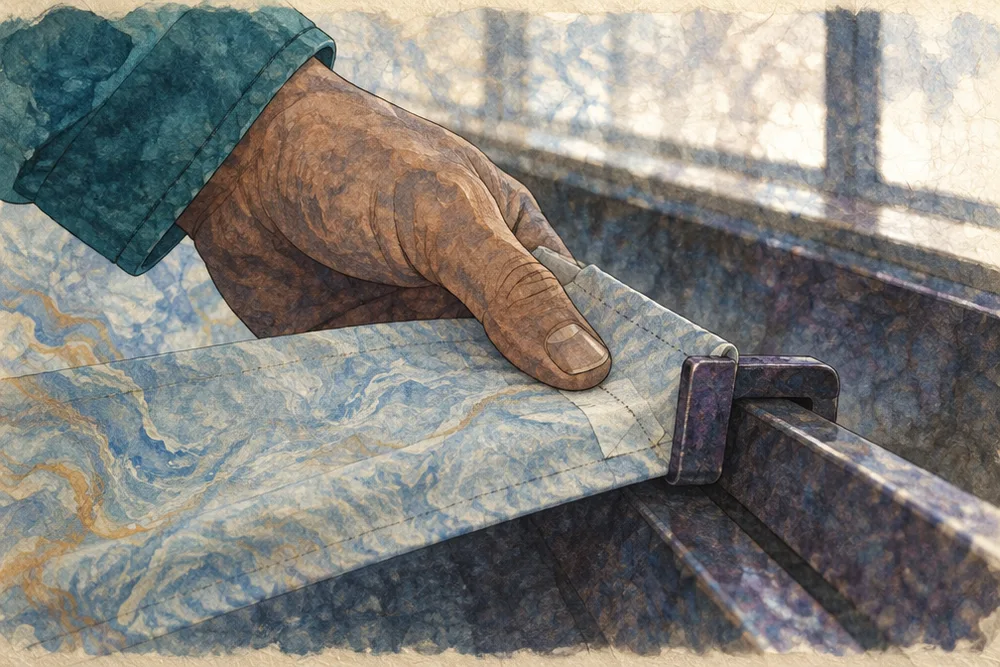
Linio unhooked himself from his tether and drifted only as far as the next rail, keeping one hand on the line. He checked the section label, then the stitching, then the folded allowance beneath it. Elva watched him press a thumb against a narrow strip of pale fabric sewn into the join. The repair was almost invisible among all the different whites, a small rectangle with one corner turned inward.
“This is the old patch,” he said. “My father’s.”
Elva remembered the story he had told them when the retired hems first came out of municipal storage: his father had kept the linen loop running through a succession of minor failures, repairing the seams before the city’s inventory ever noticed there had been a problem. Linio had described him as quick with a needle and quicker with a reason not to file a report. They had all been grateful for those shortcuts. Until now, the fold had stayed tucked because of them.
“The stitch line’s backward,” Linio said. He did not look up. “He patched this one from the wrong side. It passes a wash and sits flat in ordinary use, but the turn catches the allowance. I should’ve seen it when I mapped the run.”