The Moon in the Fitted Sheet
Page 17 of 303
Chapters
Elva left the lamp on. The decision made her feel both foolish and strangely calm. She had always thought she left the light on because she was afraid of the dark. Hesta used to tell her that the fear was not a flaw; it was a request for company. Elva had grown old enough to understand the words and young enough to keep resenting them. Tonight the light was not for her. Or it was for her and someone else, and that was as close as she could get to knowing.
The station ventilation whispered through the ceiling. Somewhere beyond the apartment, a lift rattled through its shaft and stopped at another deck. Elva tried to imagine the rest of the station: sleeping rooms set around the central spine, transit tubes curving out toward the docking ring, laundry belts carrying sheets through their cycles. Ordinary people were asleep under ordinary covers, unaware that the linen system might be connected to a landscape under clouds. She wondered how many beds contained a seam like hers, how many corners were folded over a hidden place.
She found a blanket in the storage compartment and wrapped it around her shoulders. She did not use the bed. Instead she settled in the chair beside it, where she could keep the moon in view without leaning over the mattress. The chair’s upholstery scratched her bare ankles. She drew her knees up and listened for the shutter’s answer. Nothing came for several minutes. She started to drift, then woke at the pulse of the lamp and found the cloud break still there.
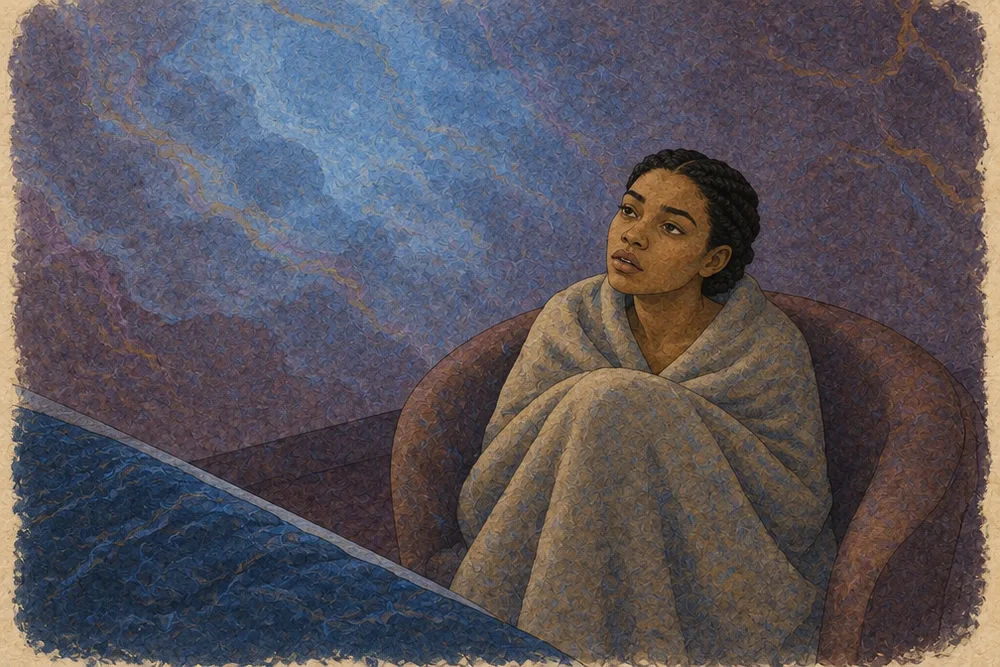
A line of blue appeared behind the shutter, faint and brief. It opened once, paused, then opened twice more. Elva sat forward. The sequence was reversed, or perhaps she had counted badly; the tiny shape vanished before she could decide. She raised the lamp and repeated the old call. Three flashes, a pause, one. The moon gave no answer this time. Elva lowered the lamp slowly. It was enough that the signal had gone both ways once. She could wait for morning before asking what it meant.
She did not sleep in the chair, but she stopped fighting the night. The station clock advanced by minutes. Her eyelids sagged and lifted. The moon stayed in the shallow basin of the sheet, turning in silence. Twice she thought she saw movement among the cloud breaks; once she was certain the shutter had opened, but the lamp’s pulse had crossed the surface at the same moment. She made herself wait before signaling again. A call made too often might be noise. A call made once might be an accident. She wanted to leave room for the other side to choose.