The Moon in the Fitted Sheet
Page 144 of 303
Chapters
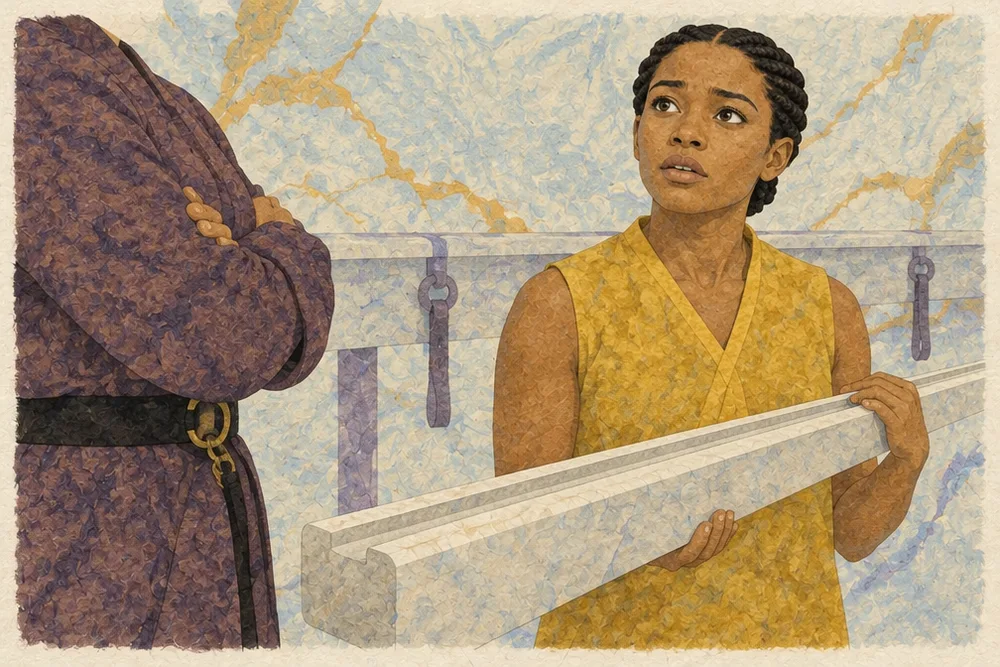
The block meeting filled the laundry commons because it was the only room with enough tether points for a crowd. People hooked their belt loops to the rail or anchored themselves with one hand while the rest of them drifted. Elva had brought a section of partition track as a sample. It hovered between her hands, a pale composite strip with two latches and a shallow groove for a sealing bead.
Linio had come from the municipal counter in his teal smock, copper coils gathered under a net. He held the track steady while Elva explained the checks still pending at the ring, the ward’s needs, and the lack of sound partitions. She kept to the practical facts. The ring could take a small group if the checks cleared. The wards had detachable beds, but no walls to separate them. Each donated panel could turn a shared berth into a place where someone might sleep without hearing every other person breathe.
“And if we lend them,” said Mrs. Olan from apartment six, “we get them back when?”
Elva looked to the track. She had not thought to ask Hesta for a date. “I don’t know.”
“That’s not lending,” someone said. “That’s giving.”
“The ring is a temporary arrangement,” Elva said. It sounded unconvincing even to her. “We’re trying to make it safe for the ward while the station changes over.”
“Changes over to what?” asked a man at the far rail. “No gravity, no proper plumbing, no walls in the only place you say patients can go?”
The question hit the room more heavily than the loose strip of track. A few people nodded. Elva knew the objections were not selfishness. Her neighbors had small homes and crowded lives. A partition separated a child’s bed from a cooking counter, or one partner’s shift sleep from another’s late meal. It was privacy, not decoration. Asking for it meant asking people to live more exposed for a plan they had not chosen.
“We’re not asking everyone,” Linio said. He leaned on one elbow, voice level. “The partitions are designed to move. That doesn’t mean no one gets to refuse.”
Mrs. Olan folded her arms. “If everyone who has a spare says no, what then?”
No one answered. Elva knew what then: if the ring cleared its checks, it would have beds, but patients would have to live in one open room beside the pumps. She could not make the ward’s need smaller by explaining the cost of a wall. But she could not tell anyone else that the cost was nothing.