The Long Walk of the Tide Clock
Page 10 of 223
Chapters
“Then we don’t go,” Tern said. He stood with elbows out, hands on his hips. “But the cart’s sound enough to reach the saddle if we watch it. If it worsens, we stop.”
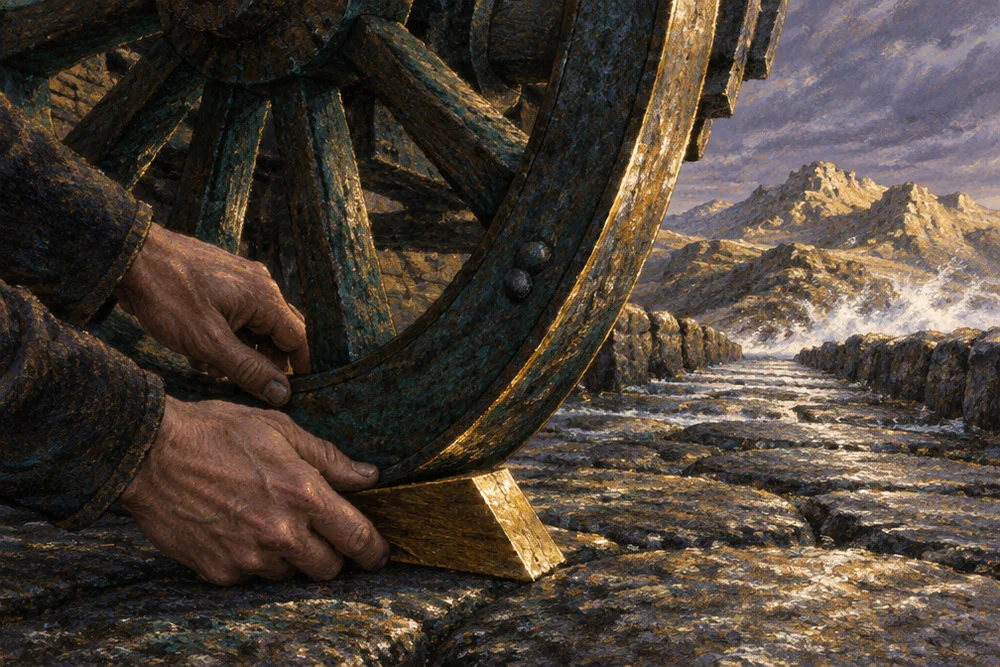
Dari ran a finger over the left rear rim. The wheel rocked against Nial’s shim, then held. Their own equipment was packed; the ledger sat in the tool roll; the clock was upright and strapped. The clock’s hands showed the morning advancing with a steadiness the causeway could not promise.
“We inspect the hub when we reach the first safe place,” Dari said.
Nial’s mouth tightened. He did not argue. He drove the shim in another fraction and stood.
Tern slapped the cart rail. “There. We’ll take it slow.”
Eda looked at the exposed stones and then at the clouded horizon. “Slow is only useful if it’s still moving.”
The workers put their shoulders to the cart. Dari walked beside the cabinet, close enough to catch a shift but not close enough to prevent one. The shop bell fell silent behind them. Ahead, the causeway lay open, its two stone ridges separated by the shallow saddle.
The first part of the road was almost easy. The cart wheels bumped over seams between the stones; the crew lifted the handle over a shallow gutter, and the clock held steady. Wind pushed spray across the lower road, light as breath. Dari kept one hand hovering near the cabinet’s side, not touching it unless the movement demanded a correction.
At the causeway’s first ridge, the water fell away on both sides. To the left, the estuary stretched toward Latchport, a broad slate-coloured plane broken by distant moorings. To the right, the outer water ran behind the islands, its surface scored by currents that looked calm from this height. The path ahead descended to the saddle, a strip of pale stone where shallow water still crossed the cart road.