The Last Shift at Dusk Radio
Page 176 of 181
Chapters
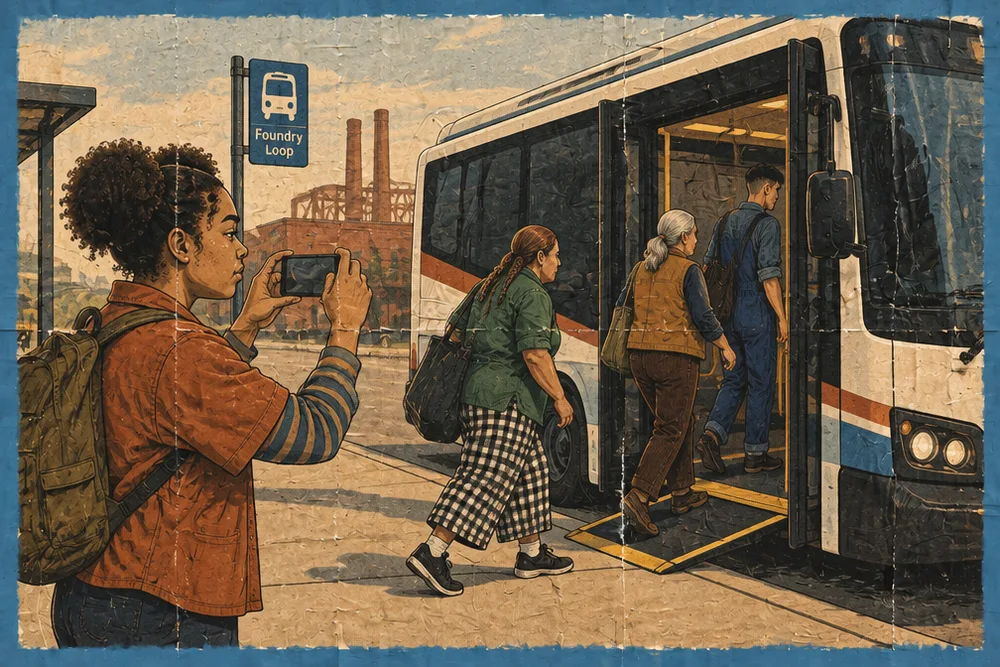
Omar climbed aboard first. He touched his transit card to the reader and turned to say something to the driver. Zadie could not hear what passed between them. He stepped farther inside, moving toward a seat near the front. Inez waited while another rider came from the canteen, a woman with a canvas tote and a knit cap pulled low. The driver lowered the bus again for her, although the curb was already level enough to step up from.
“That counts too?” Zadie asked.
“It counts as the bus doing what the stop says it will do,” Inez replied. She marked the step-free boarding in the notes column, not as a special favor but as part of the service recorded.
The driver shut the doors. The bus eased away, indicator blinking as it merged with the road. Zadie watched its red tail lights cross the dark and vanish behind the warehouse. Nobody cheered. The first departure had happened at the listed place, close to the listed time. It was a small thing, and the importance of it depended on what happened on the next night, and the one after that.
Inez checked the timetable again against the time she had written. “We keep the record,” she said. “If it’s late, we write late. If it misses someone, we write that too.”
Kit picked up the old poster. Its pencil circle around the bridge approach had caught the shelter light, a gray mark on yellowing paper. “Want me to throw this out?”
“No,” Zadie said, then paused. She did not want the wrong map to become proof that people had been foolish for trusting it. “Keep it with the dated corrections. It shows what we changed.”
Kit folded the old poster carefully along its existing seams and slid it beneath the stack of new maps. He would bring it back to the shop and file it with the dated corrections, not put it in the wastebasket. The old mark would remain visible, but it would no longer be the only instruction a rider could find.
Zadie stood beside the shelter, listening to the bus’s sound disappear into the traffic hum. For an instant, she imagined the studio upstairs: the red ON AIR lamp, the board under her hand, Perry’s farewell script with its neat final sentence. She had wanted the last broadcast to prove that she could tell an important story. Instead, she had learned that a story could be important and still not belong to her.
The recorder in her pocket was not there. She had left it at home before coming out. She had not brought it to the review meeting, either. The absence felt different from making a point of refusing to use it. It was simply not the tool this moment required.