The Last Shift at Dusk Radio
Page 173 of 181
Chapters
Still, the chair said the rider logs had influenced the decision. Zadie felt Inez’s elbow brush hers. Inez did not smile; she was reading the conditions on the handout as though checking a food order before sending it out. At the end, she folded the page carefully into her folder. “Twelve weeks,” she said. “Then we bring the papers back.”
Outside, the afternoon was bright enough to turn the river into a strip of hammered tin. Kit waited on the steps with a roll of proof sheets under one arm. His cobalt apron was streaked with dried paste, and a black smudge crossed the side of his hooked nose. He had come from the print shop when the review began and had spent the meeting sketching possible revisions to the map on the back of an envelope.
“They went for the stop,” Zadie said.
“They went for a trial,” Kit corrected, but not unkindly. “The stop is part of it.” He unrolled a proof against the brick wall. On the new map, Foundry Loop was marked on the west bank with a small blue square. The hospital departures had been listed in a column. A blank box beside each stop was labeled MISSED? Kit had made the letters large enough to read from the shop window.
Inez leaned in to inspect it. “The time at the hospital needs to say departure, not pickup. People might think the bus waits there.”
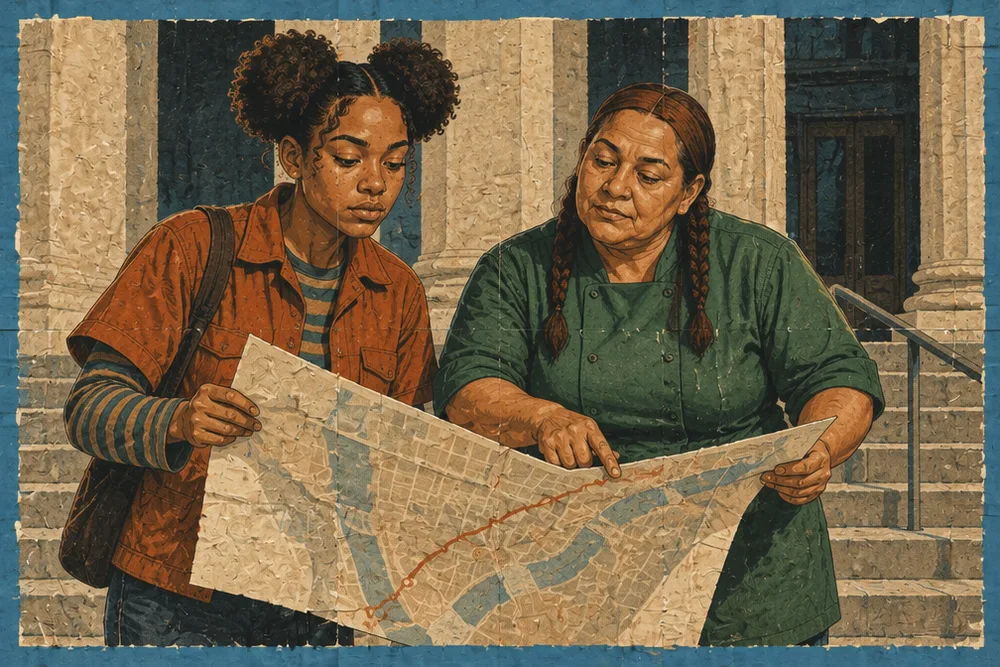
Kit took out his pencil. “Good catch.”
Zadie watched him change the wording. The paper was only a proof, the ink not yet set, and still the correction felt like the actual work: someone noticed a possibility of confusion; someone else made space for it to be fixed. No one needed to claim the map as theirs. It belonged to whoever used it and whoever was willing to mark it wrong.
The pilot’s first night was ten weeks after the transmitter’s last sign-off, and Zadie reached Foundry Loop early enough to see the sun leave the west-bank warehouses one wall at a time. She carried no station headphones, no microphone, no recorder. In her coat pocket was a folded copy of the pilot timetable, softened at the creases from being checked all afternoon.
The stop stood near the entrance to a staffed canteen, not at the old bridge approach. A shelter had been cleaned and fitted with a bench. Its glass carried pale scratches from earlier stickers and a fresh notice in a clear plastic sleeve. The painted route marker was new, the lettering still sharp. Across the road, a shuttered warehouse wore a faded mural of a blue heron. In daylight, the place looked less like an answer than like a place where a person might reasonably wait.