The Last Bus Was Ours
Page 172 of 229
Chapters
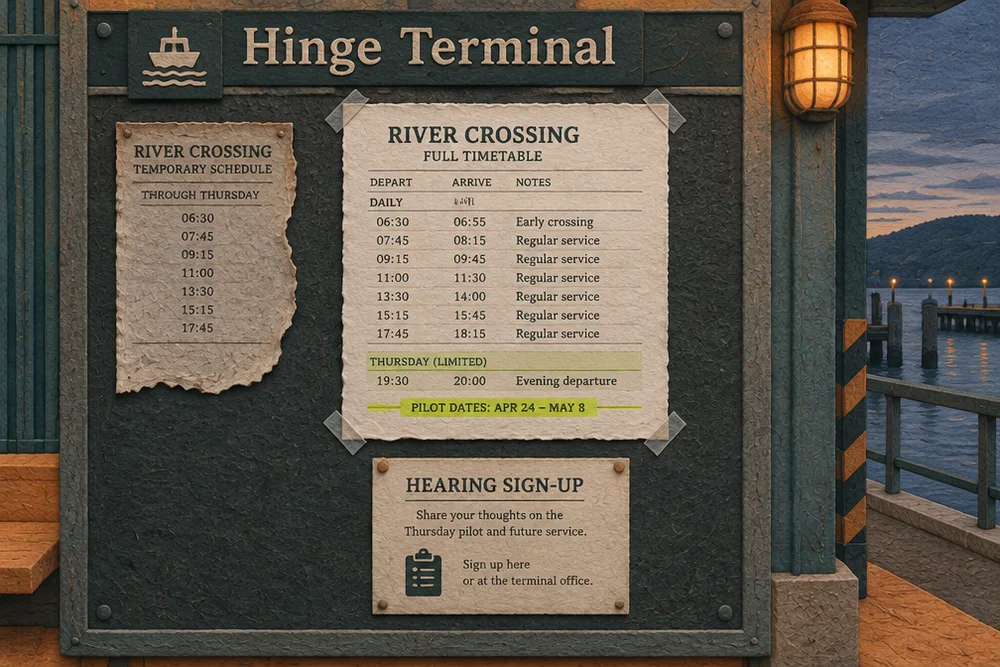
At Hinge Terminal, Orin taped the timetable beside the old cut notice. He placed the new sheet at eye level and kept the route’s full schedule visible: the early crossing, the daytime trips, and the limited Thursday departure. A sharp lime line marked the pilot dates. He did not cover the hearing sign-up details below.
Arel came in carrying a stack of market copies. She inspected the timetable, then ran her finger down the list of dates. “All six,” she said.
“All six.”
“And the five-twelve?”
Orin pointed to it. “Still there.”
She looked at him a moment. “Don’t make it sound like the market bought the morning bus.”
“I won’t.”
She handed him the extra copies. They posted them at the market entrance, by the shift board, and in the break room. Orin wrote the departure time beside each copy in his notebook, not because he expected it to change, but because he wanted to know where people could see it.
Arel asked if he would be there for the first trip. Orin said yes. “I want to record who rides and who can’t get on.”
“Good. Ask before you photograph anybody.”
“I will.”
She turned toward the shuttle doors. Before she left, she said, “The people who stopped taking Thursday closes aren’t all coming back just because you posted a time.”
“I know.”
“Then show them what happens. Don’t promise the next six.”
Orin watched her join the departing workers. He wrote that instruction in the notebook, under the line about the departure. It felt less like a lesson than a task he could be held to.
At home, his charger cable was still looped around two fingers. Uma had let him keep it when he needed it, and he had not returned it yet. He found the white cable in his bag and wrapped it neatly, careful not to strain the orange relief at the plug. Tomorrow he would bring it to Spar Yard Studio, or ask Uma where she wanted it left. He would not assume that a small debt settled the larger one.
The terminal announcement sounded overhead. Orin folded the unused copies into his folder and looked once more at the board. The empty bay offered no evidence that the pilot would work. The posted timetable offered a departure people could test. For now, that was what he had: not an assurance, not a pledge, but a date, a driver, a price, and a public way to find out whether the crossing mattered enough to keep.