The Kite That Carried the Border
Page 70 of 224
Chapters
He had expected her to defend the first kite’s line, or the clerk’s entry, or the convenience of making the camp vanish from a record. Instead she had found a defect and named it. It did not settle what was his. It made it harder to pretend that ownership alone would solve the problem.
A wheelbarrow stood near the far wall, its single wheel resting in a groove. Someone had left it loaded with three sacks of flour. The barrow was too wide to pass between the rock rib and the shelf without turning sideways; even then, its handles would strike the clay post.
Tess measured the opening. Iven watched the numbers gather in her mouth before she spoke them. “A standard sack cart needs this much clearance. The passage gives us less.”
“Then the camp has been using a smaller cart.”
“A hand barrow. It takes one sack at a time.”
“And mine?”
“The barrow in your household inventory is wider.”
He had not told her that. The inventory was written on the reverse of the lease strip, tucked beneath the annex. Iven pulled it out and showed her the line. The cart had belonged to his grandfather. Its iron wheel was still in use, according to the latest household tally.
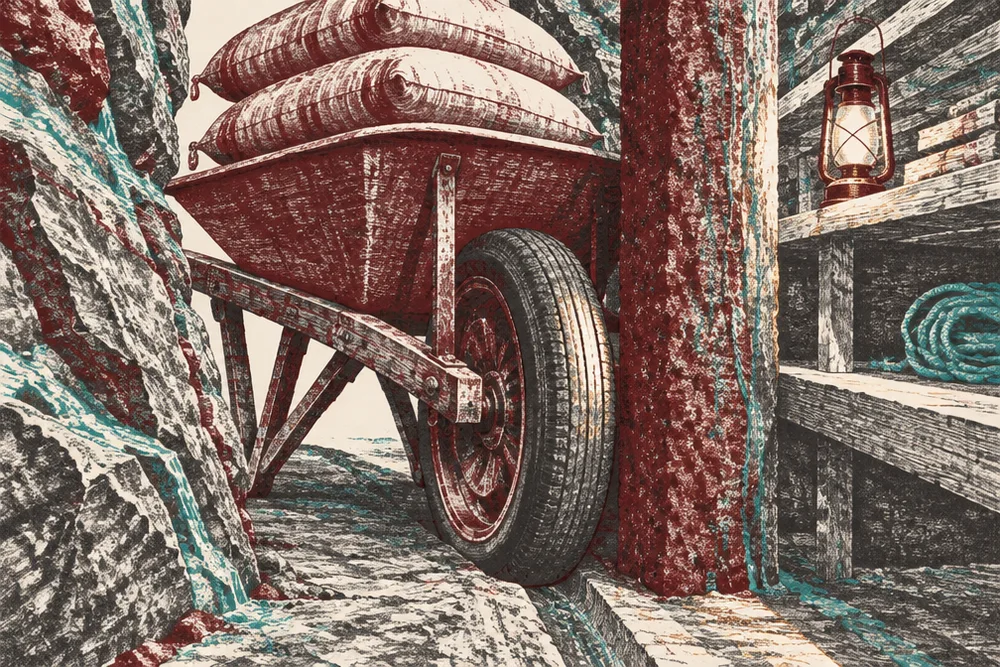
“If I bring it through,” he said, “I have to put it over the shelf or take the lower route.”
“The lower route is the one that floods.”
“In prolonged rain.”
“This is a winter store.” Tess tapped the level’s brass edge against her palm. “We can’t treat the flood as a rare inconvenience.”
He hated that she was right in the practical way, the way that left no clean opening for a clever reply. He looked again at the flour sacks, the worn groove and the people’s things under the shelf. He could argue that the objects were temporary. But the shelf boards had been fitted to the stone, and the bowl was set within easy reach of the boots. Temporary things did not always stay temporary because a survey chose not to notice them.
“Show me where it floods,” Iven said.
Tess pointed past the flour. At first he saw only a black interval between the sacks and the wall. Then he took his lantern off the floor and the interval acquired a roof. The lower passage came into the bay at a slant, low enough that whoever brought a cart through would have to walk to one side of its handles. He knew the other end: a cut below the Rusk entrance where the old carters used to stop and wind cloth round their wheel rims to quiet them on the stone. He had never come through from this direction.