The Hour We Drew Together
Page 55 of 242
Chapters
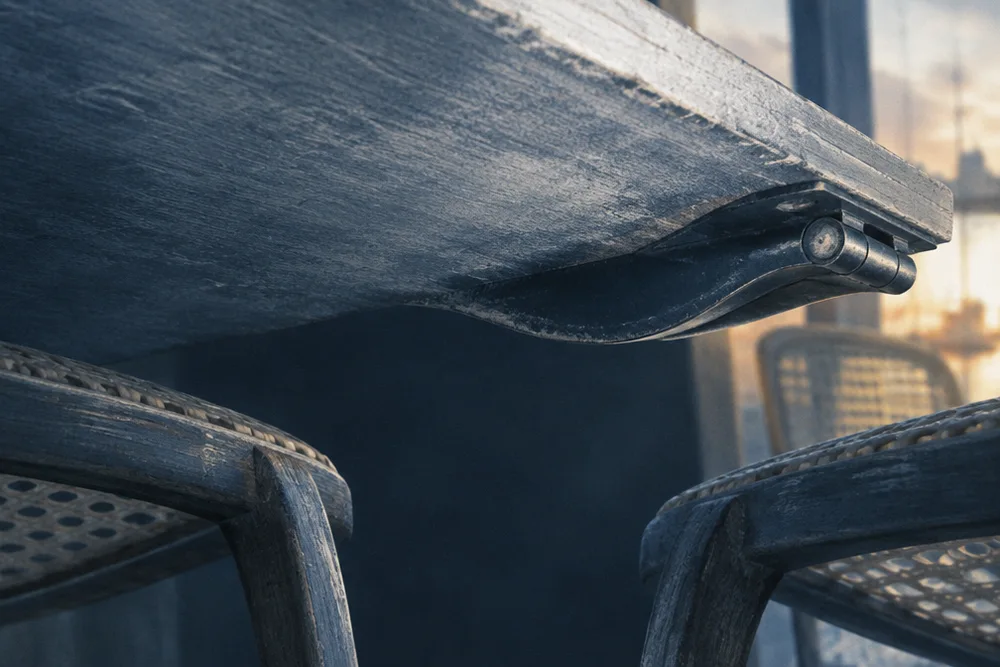
They raised the top and laid it across two café chairs. The warped hinge was easy to spot once it no longer bore weight. The strut was sound, but its bracket sat a finger’s width out of square. When Ewan had drilled it, the board had been balanced on his van floor, which was not level and had not been meant for precision. He’d known that too. He’d trusted the finished bench to hide it.
He measured from the hinge pin to the end of the strut, then from the bracket to the bench’s outer rail. The measurements disagreed by almost a centimetre. He drew them on a brown paper bag Jo had given him for the job, marking the hole positions with a carpenter’s pencil.
Fenella stood at his shoulder, following the marks. “If the whole top came off, the frame could stay put.”
“It could.”
“Then the sewing surface could be stored separately.”
“Where?”
“On the wall, if there’s a cleat. Or flat on top of the locked cupboard when it’s not in use.” She pointed to the sketch. “The frame folds. The surface lifts. No fabric gets trapped in the hinges.”
Ewan examined the bench as though it had been built by someone else. The surface was an old sheet of laminated board, trimmed down to fit the hinges. He had made it one piece because one piece was simple. He’d attached it directly to the rails so it could not slide. He had also made it heavy enough to resist a bicycle being steadied on it, which made it heavy enough to twist the brackets when the frame shifted.
“If it lifts off,” he said, “you need a way to stop it skidding while you work.”
“A lip.”
“A lip catches cloth.”
“Not if it’s shallow.” Fenella’s hand moved over the imagined edge. “A removable strip. Smooth surface, no screw heads where a sleeve can snag.”
He wrote that down. Her idea changed the shape of the job, not just the repair. That was the trouble with working beside her: she looked at the part he had chosen and asked what it was supposed to do for the person using it. He had been designing a bench that folded. She was designing one that could become a sewing station without carrying the bicycle-work mess into her fabric.
“The frame can have a crossbar here,” he said, sketching beneath the top. “That’ll stop the legs walking outward under a load. The removable sheet will sit on rubber pads. I can make a shallow locator strip at either end.”
“And the cut edge?”