The Hour We Drew Together
Page 156 of 242
Chapters
“The dates are still tentative.”
“Then write that in large letters.”
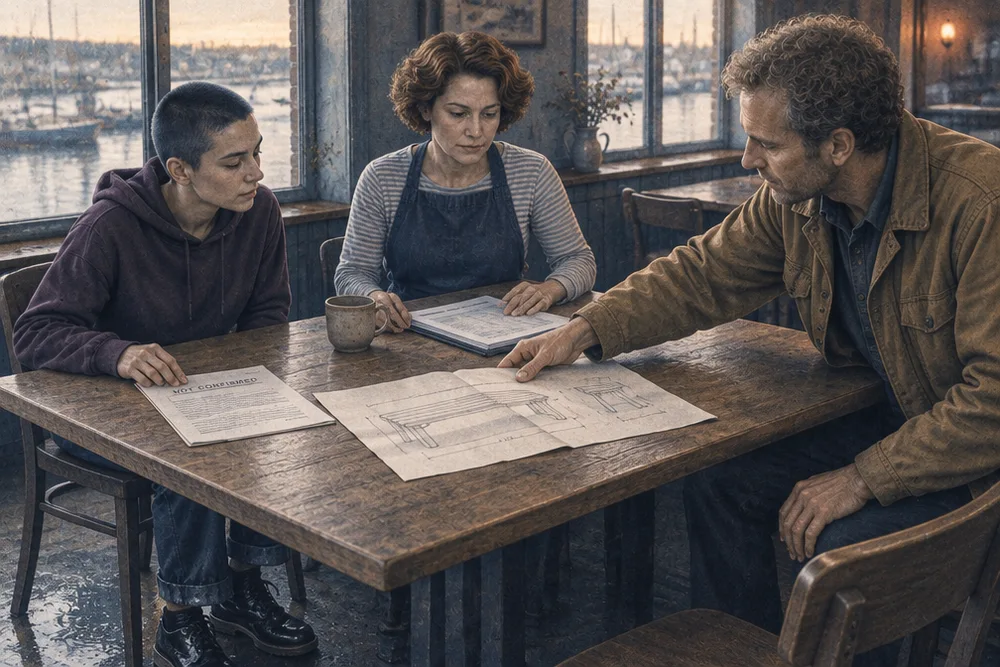
Fenella did. She took the page back and added NOT CONFIRMED at the top, underlined once. The plainness of it pleased her. She was not trying to sell certainty. She was trying to find out whether the uncertain thing could be made workable.
Ewan came in just as Kit finished reading. He had a folded sheet of paper tucked into his jacket. “Bench dimensions,” he said. “It’ll clear the aisle if the rack moves. The seller will hold it for two days.”
“What’s it cost?” Fenella asked.
He named a figure low enough to be tempting, but not so low that she could imagine it without a repair attached.
“We’ll inspect it before we agree,” she said.
“Of course.” He unfolded the measurement sketch. “There’s room for four students with the bench there. Five would pinch the aisle.”
“We have four places, not five.”
“Exactly.” He looked at Kit’s annotated terms. “Progress?”
“Three likely reservations, maybe a fourth if the rota fits,” Kit said. “And they won’t lose their money if the room doesn’t open.”
“That’s the important bit.” Ewan set the dimensions beside the revised budget. They sat around the table, the three of them, with the paper terms and the empty line for bookings between them. Nobody put a coin down. Nobody asked them to.
At the end of the week, Fenella laid the documents in order on the table in the waiting room. Revised budget. Council estimate for basic works. Café receipt. Student-interest list. Draft deposit terms. Secondhand bench dimensions. The pages did not make a complete application yet, but they had stopped being a collection of hopes. Each one answered a question that could be asked aloud.
Ewan brought the bench over on a small handcart. The seller had let him bring it over to check the fit before they decided. The top was worn smooth in the center, the lower brace loose but sound enough to repair. They moved the tool rack four inches, checked the aisle with Ruth’s measuring tape, then folded the bench. It settled against the wall without catching the cabinet door.
Fenella walked from the raised street door to the sink, then back to the table. Her hip passed the bench without turning sideways. The aisle was clear. The room was still bare, but it was usable in the way they had promised: not by squeezing one business into the leftovers of the other, but by keeping a path open between the work and the street.
“I can make four places work,” she said. “The machine stays at the far table, only if the outlet is cleared. Handwork can start without it.”