The Hour We Drew Together
Page 123 of 242
Chapters
Fenella’s fingers rested on the papers. The decision was not whether she could manage. She could. The decision was what she wanted the room to mean, and whether wanting to share it was the same as needing Ewan to make it possible. She had spent most of her adult life arranging matters so that no one could find a handle on her. Money saved; work carried alone; no debts of gratitude. Security had looked like being impossible to disappoint.
“If I say yes,” she said, “I don’t want it to be because I’m afraid there won’t be another chance.”
“Then wait a day. But don’t confuse deciding alone with being safer.” Jo stood and lifted the teapot. “It’s only safer from one kind of trouble.”
Fenella glanced at her. Jo was already walking toward the counter, leaving the sentence with her. Outside, the wind brushed the café window with a handful of leaves. Fenella studied the budget again. The totals remained sensible. The offer had not changed while she drank her tea. What had changed was that she could see the life it described.
At home she spread the survey across her kitchen table. The paper was creased where it had been carried down to the landing, and pale chalk dust still marked its edge. Fenella weighted the corners with a sugar bowl, a spool tin, and the brass scissors she kept for cutting paper. The drawing showed the waiting room from above: door, sink, windows, aisle, benches folded to the wall. Ewan’s lines were in a darker pencil. His notes crowded the margin, practical and slanted: wheels secured; tool chest; clear access; changeover twenty minutes.
Their plan had fitted both businesses by making time part of the floor space. Sewing in the evenings and on certain mornings; repairs in the other hours. The benches folded; the storage locked; a paid interval to clear one trade before the next began. It was not an airy compromise. It had survived actual customers, a jammed bench, a ruined sample, a bell rung too late. It carried costs because it had been tested against work.
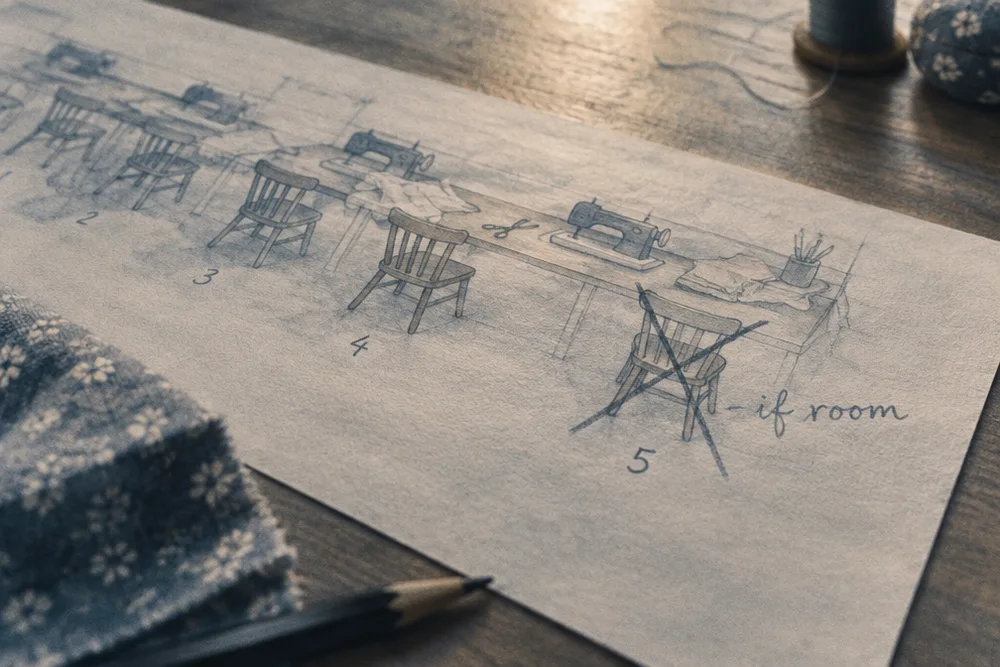
Fenella turned the paper over. Her own rough version was there, from before they had combined measurements. Four sewing stations, then five crossed out. She had drawn a shelf where the shared storage now stood. Beside the fifth chair she had written, in her own hand, if room. A small notation, but she remembered the feeling of it: wanting more places than the room could hold, wanting to make a promise before she knew if she could keep it.