The Credits After the Chime
Page 84 of 253
Chapters
A guitar began, soft and clean. Tessa had chosen a song with no sharp drum entrance, because she imagined the plant break room full of people in ear defenders and tired faces, the song easing into the room like somebody opening a door carefully. She had found the track on the station’s approved library and checked the license twice. The whole segment ran two minutes and forty seconds. She knew because she had timed it with the timer on her microwave.
Renato listened with his gaze lowered to his mug. The music filled the kitchen, though not enough to reach the back hallway. Tessa watched his face for the moment recognition arrived—not of the song, exactly, but of her effort. She pictured him on a break, telling someone that his daughter had put the piece together. She pictured the story traveling back to her from somebody else, changed a little, which would prove it had gotten out.
The guitar ended. There was a click from the phone speaker, a barely audible one she had meant to remove. Then the recording stopped.
Renato rubbed his thumb over the mug handle. “You made that at the turnout?”
“Yeah.”
“You said the road runs three hours before it finds a river.”
“It does.”
“And then the song’s for people whose hour belongs to a clock.” He looked up at her. His eyes were red around the edges, the way they got after a long shift. “You mean me.”
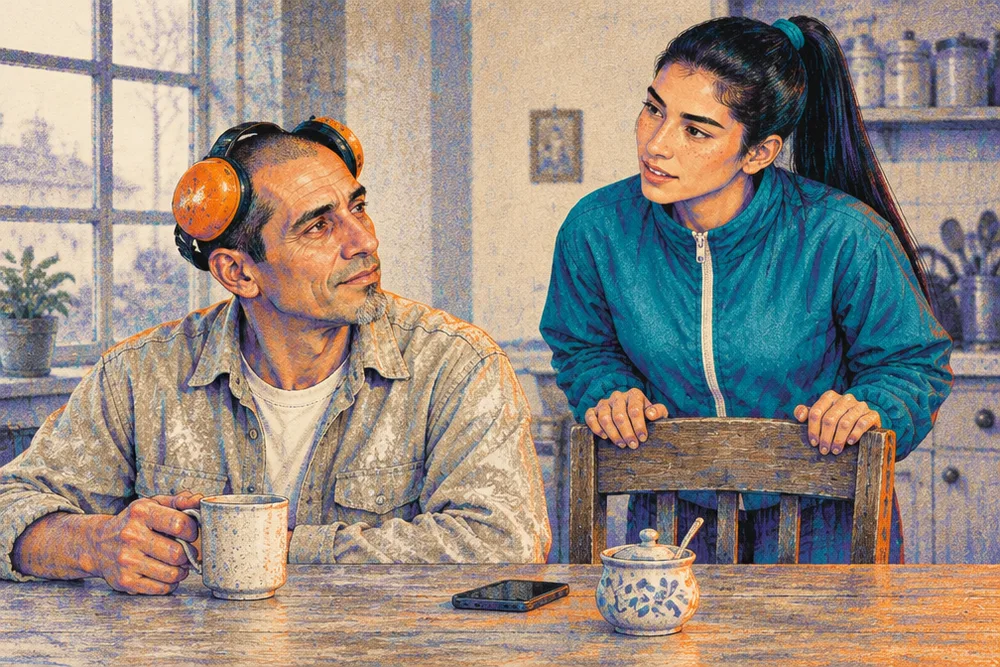
“I mean you, and people like you. I’m not saying anything bad.”
“I know.”
Tessa sat down opposite him. She had been standing with both hands on the back of a chair, chin pushed forward, like she could lean the recording into him. Now her knees bumped the table crossbar. “Did you like it?”
Renato tipped the coffee pot into his mug, though there was only enough left for a swallow. “The guitar was good.”
“The guitar was already good.”
He gave her a small smile. “Then your levels were good.”
She waited. The silence had length to it. In the recording she had used wind as atmosphere, a truck as punctuation, the far-off glow of the plant as a backdrop. She had not said the company name, but she had made the place into a scene, and Renato into the person who gave the scene its meaning. That was what radio did, she thought. It selected. It made something fit in the time between songs.