The Credits After the Chime
Page 162 of 253
Chapters
“We can make the show monthly,” she said. “Not a weekly rotation. One live night, once a month. Then reruns in the other weeks.”
June looked up. “And who hosts the live one?”
“Whoever’s on the roster.”
“Which means somebody still has to commit.”
“Yes. But it’s one night.” Tessa stopped, aware how easily the sentence could sound like she was shaving June’s objection down to fit her plan. “It could be one night when you’re free. If you aren’t, it’s someone else.”
“What if I’m free, then I’m not?”
“Then somebody else.”
“And if nobody else is ready?”
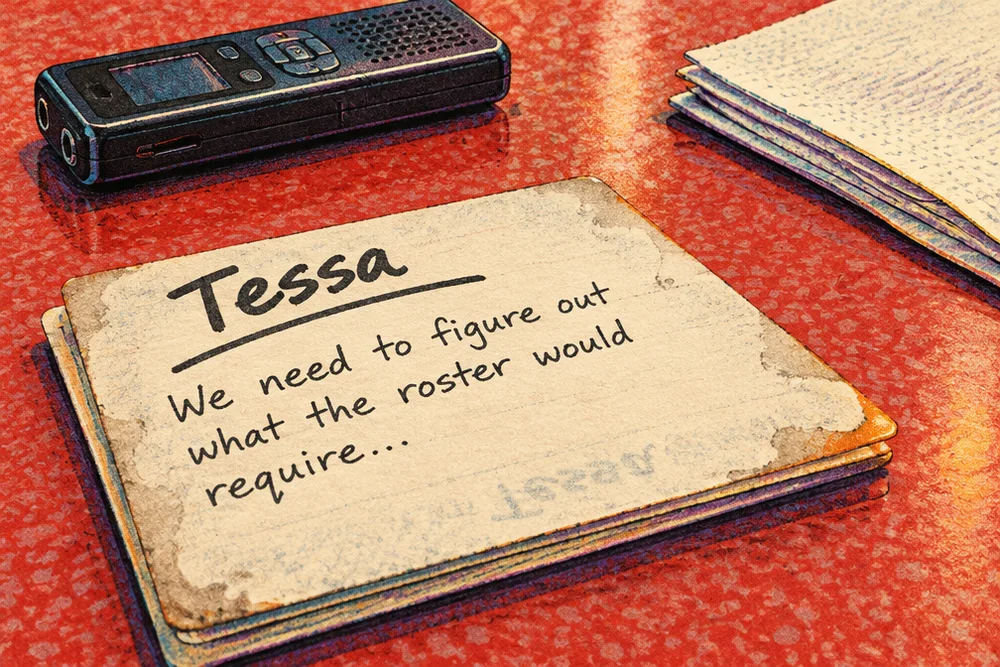
Tessa reached for the cue cards. The stack was damp at the edges from condensation on her glass. She straightened them one by one, though they were already straight. The top card had her proposed order: opening, route report, film segment, percussion break, songs. Her own name was written above the opening in thick marker. She’d made that list before the crew had agreed on anything. The letters looked bigger than they needed to be.
Dorian slid the recorder a few inches away from the napkins. “This is the part where we decide whether the roster is a schedule or a test.”
“It’s a schedule,” Tessa said.
“Then it needs a way to change.”
Ivo stopped rocking. “A swap rule?”
“A way to say no,” June said. She didn’t raise her voice, but the words seemed to settle on the tabletop between them. “Not just a way to trade shifts after I’ve already agreed. I want to be able to say no on air. Or before air. Without everybody having to convince me I’m letting them down.”
Tessa looked at the card. The felt marker had bled faintly through the paper, leaving a backward shadow of her own name on the next sheet. She remembered the first time she’d tried a dedication from the gravel turnout, speaking toward the plant lights as if a song could reach her father before his break ended. She had wanted him to hear something she made. Somewhere along the way she’d made hearing it into proof that she deserved the slot.
“You should be able to say no,” she said.
June studied her face, deciding whether the words came with a hidden condition. “I don’t want to be the person who makes the plan fail.”
“If the plan fails when one person says no, it’s a bad plan.”
The answer came out simple. Tessa was surprised by it. She had thought there would be a cleverer answer, something that made the schedule look generous without making anyone inconvenient. Instead she saw the obvious flaw: a rotation could be another kind of single-host rule if every turn was treated as a debt.