The Credits After the Chime
Page 113 of 253
Chapters
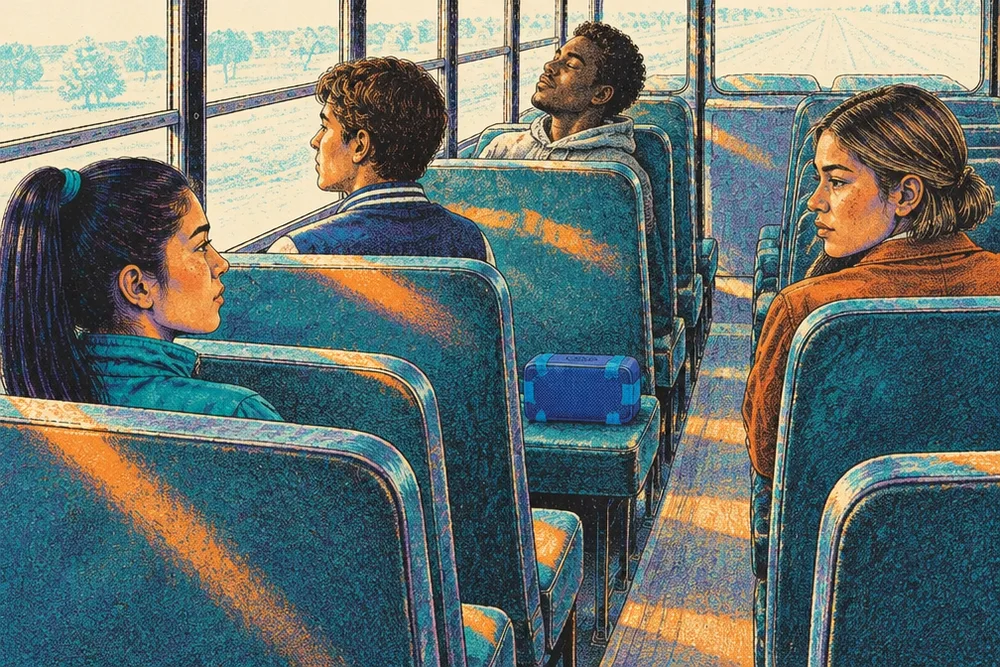
The next day, Tessa took the new cut onto June’s bus loop. She did not introduce it as an experiment. June only said, “I have a short piece to play,” and turned the speaker toward the rows of seats. Tessa sat halfway back, out of June’s direct line of sight, with her notebook closed on her lap.
The description began without a crackle or an old-fashioned voice. Listeners heard Tessa name the slate, the empty uniforms, the blank tags. She described each child pinning a name onto a garment that no one wore. When she reached the row of tags, she paused long enough for the image to settle before explaining that the film had been made by students as a parody of safety instruction.
At the first stop, a rider with a grocery bag asked, “So they were mocking the idea that workers were just labels?”
“That’s what the frames suggest,” June said. “We’re checking the class credit and what the student group called itself.”
The rider nodded. “That makes sense.” He did not ask whether the voice was real. He did not mistake Tessa’s description for an old recording. He had nothing to mistake it for.
At the second stop, a teenager with a school jacket said he could picture the children lining up tags. He asked whether the film was funny. Tessa felt the old impulse rise: play the laugh, prove the joke. She kept her mouth shut. June answered that the frames had a comic repetition, but the surviving strip had no soundtrack, and they did not know what sound the filmmakers had used.
“So you’re not putting a laugh in?” the teenager asked.
“No,” June said. “Not as if it came from the film.”
Tessa made a small mark in her notebook. She did not write down the rider’s name. She did not need it.
The bus bumped over a patched stretch of road, and the speaker rattled against the seat. Tessa watched the passengers more closely than the waveform. Some looked out of the windows; one closed his eyes. Nobody leaned forward, and nobody laughed. The piece did not command the bus. It took up a few minutes and then let the route continue.
At the final stop, a woman who had been listening with her hands folded in her lap said, “I understood it. But I don’t know if I would’ve noticed the tags without you describing them.”