The Fourth Tick Went Missing
Page 40 of 270
Chapters
She picked up the folder and carried it toward the Blue Office, the old drawing and slip held flat between its covers. The caretaker’s room was narrow enough that the landline cord looped over a drawer handle. Carbon-copy passes sat in a metal tray beside the fast clock. At the half hour, the minute hand would jump ahead as if hurrying the night toward its sale.
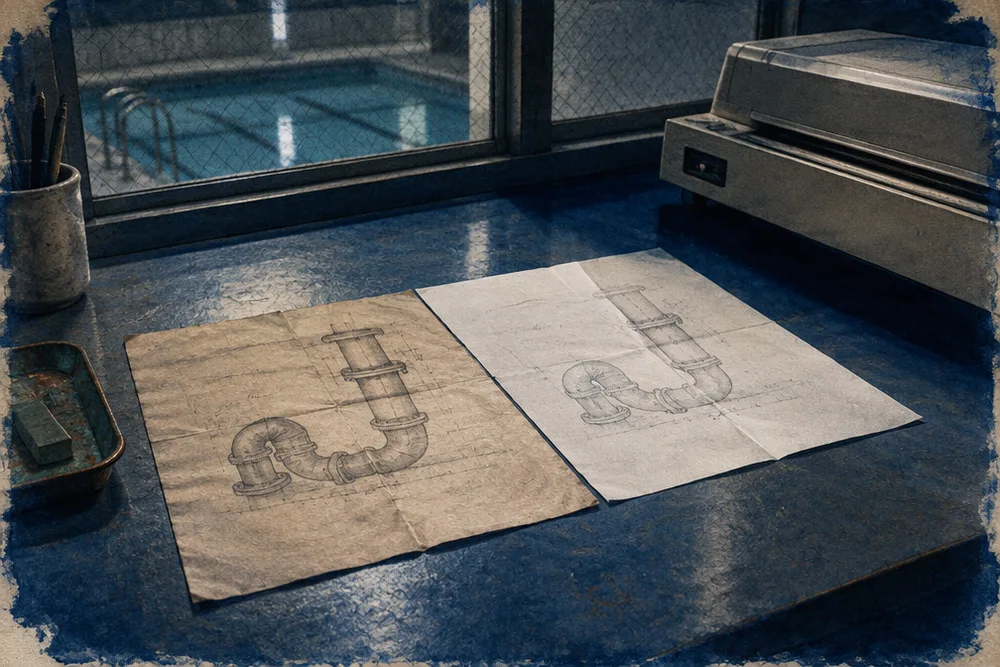
Yvette set the plan on the desk and made a copy of the cancellation slip. The machine gave a small mechanical shiver. On the copy, the date printed black and clear, but the penciled reason was lighter. She tried again with dark backing paper. This time, the words came through: child refused old ladder.
She put one copy in the folder and one beside the drawing. She did not take either to the mural. For the moment, they belonged with the old layout, not with the loose elbow tile she still meant to remove intact.
Basil stood in the doorway. “That changes the track.”
“It explains where it goes.”
“You know what I mean.”
Yvette did. The marks no longer ended in a place that had never offered a way out. They ended at the memory of a ladder that had been moved, and of a lesson that had been canceled because a child would not use it. The room had changed since then. The trail had not, or had returned in the same shape. Neither possibility was a comfort.
She went back to the pool carrying the copied slip. Basil had stayed in the doorway, giving her the narrow passage without asking if she wanted him behind her. She placed the copy alongside the original and the drawing, then pinned the three sheets with the corner of a numbered tray.
“The tracks belong to an earlier layout,” she said. She spoke the words as if recording an inventory fact. “Old ladder here. New ladder there. First lesson afterward canceled.”
“That’s what we’ve got,” Basil said.
Yvette looked again at the date on the slip. It was the first lesson after the change. The entry did not record whether anyone returned for the next session. It did not say whether the child had been a club swimmer, a laundry worker’s child, or someone who had waited through a shift to be let into the pool. The blank spaces on the pass were broad enough for all of them.
“Why does the pool remember a refusal?” she asked.
Basil’s pencil remained in its buttonhole. He did not take it out. “I don’t know that it remembers anything.”