The Fourth Tick Went Missing
Page 251 of 270
Chapters
“I don’t expect it to.” Yvette leaned over the sheet. “Keep the original entry. Keep the correction with it. Don’t make one disappear to make the other fit.”
“We won’t.” The foreman signed the condition sheet. The pen strokes made a faint scratch against the clipboard. Yvette’s eyes went to the empty space at the bottom, where the caretaker’s acknowledgment waited. Her old signature was on a hundred forms in the Blue Office, fast and legible, a means of keeping the building moving. This time she wrote slowly. Her hand trembled once when she reached the final letter. She left it as it was.
Basil shifted on the ledge. “That’s done,” he said. “The report’s started.” “It’s not done. They still have to take the mural down.” “The report’s started,” he repeated. “You said you wanted the damage recorded.” “I do.” “Then let it start.”
She recognized the kindness in that, and its limit. He did not say the damaged mural could be fixed, or that the record would be enough. He let the event remain the size it was.
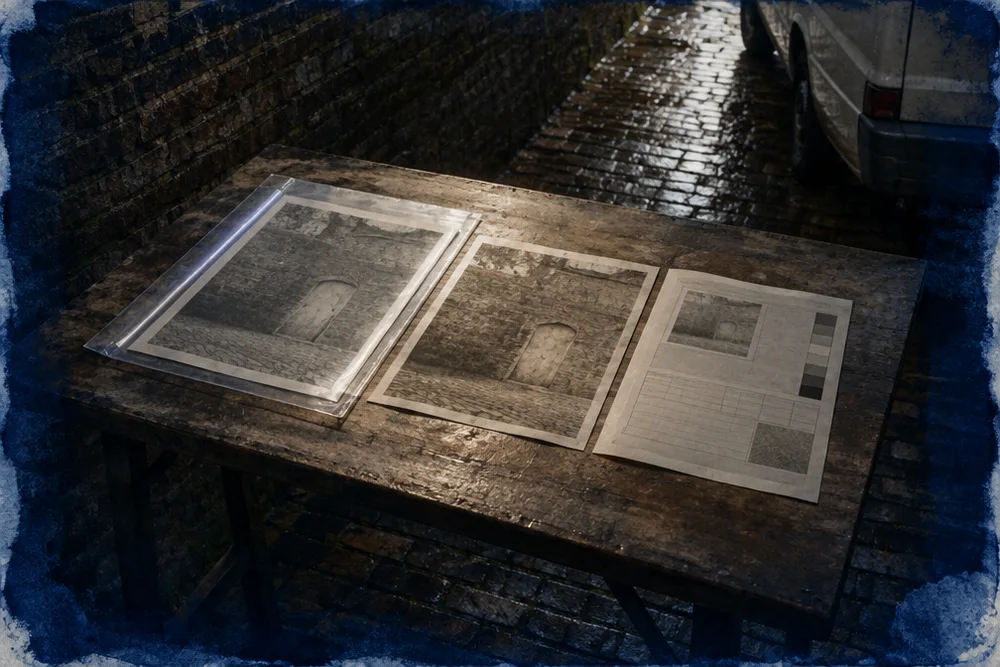
A worker opened a plastic sleeve to protect the paperwork from the damp. The photograph slid inside, its two names visible through the clear film. Yvette watched the sleeve settle flat. For one blink, the reflected alley made the names appear to float over the bricks. Then the worker lifted it, and they were only ink on paper again.
Mara asked whether Yvette wanted to accompany the crew inside for the initial inspection. She framed it as an option, not a duty. “You know the building better than we do,” she said. “You can stay outside the marked area. We’ll stop if you ask us to.”
The offer opened a door in Yvette’s mind before the actual door moved. She pictured the street entrance standing open and the pool beyond it: dry, pale, and waiting; the lane numbers laid across an empty bottom. She pictured the tracks running over the threshold, her white soles with the triangular repair continuing into the older arrangement. She pictured the worn heel with its crescent missing, one tile closer each time she filled the gap in the pipes’ rhythm.
She could go in and see whether the prints remained. She could stand by the deck and tell the crew where the mural’s support points were. She could even call it work, which would make the refusal feel less like fear. But the work did not require her body in the room. The crew had the drawing, the measurements, the marked hazard, the foreman’s judgment. The keys were not yet theirs, but the responsibility was already moving.