The Fourth Tick Went Missing
Page 242 of 270
Chapters
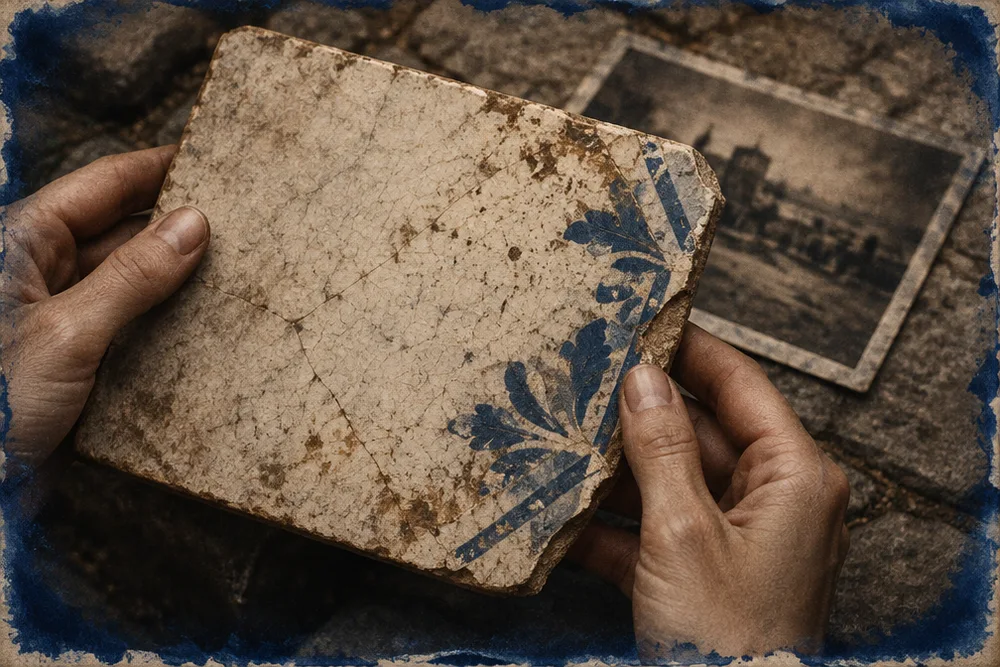
She sat beside Basil. The stone was cold through her trousers. He kept the photograph in his lap, fingers braced at its edges. They did not speak about whether the heel belonged to her mother, to the pool, or to the memory of a route laid down in another time.
Yvette drew the tile out of her coat and set it carefully on her thighs. The back was turned upward. Two sets of scratched initials crossed the clay, small enough that another person might miss them. She kept her hand beside the piece, not over it.
A thin wind moved along the street and lifted one corner of the photograph. Basil laid his palm over it. The gesture kept the paper from bending without hiding what it showed.
‘There’ll be questions,’ he said.
‘Yes.’
‘About the break.’
‘Yes.’ She looked at the tile. ‘I’ll answer them.’
He did not ask what she planned to say. The buyer would take the baths; the key transfer would end her permission to remove ceramics. The mural would remain on its backing wall in pieces, and the record would state that she had broken it. Any account that named only the damage would be incomplete. Any account that called the break a rescue would be false.
‘I’m not going to say it was an accident,’ Yvette said. ‘I chose the seam.’
Basil’s thumb stayed on the photograph’s corner. ‘All right.’
That was all. No one excused the decision. The night did not grow kinder because she had spoken it aloud. But the words belonged to her, and she had not asked Basil to sand them down.
She turned the tile once, careful not to scrape its edge against the coat buttons. The painted face was a small remnant of the swimmer’s arm, the glaze worn at one corner. On the back, the two names remained. Yvette traced neither with her finger. She had wanted proof that leaving her mother did not make everything between them meaningless. The tile had not proved that, exactly. It had given her something less complete and more solid: a piece they had both touched.
They waited without counting. The street remained ordinary. Rainwater moved along the curb. From the town above the ridge came the softened roll of a cart, then the faint slam of a door. Somewhere beyond the converted laundry, a boiler fired and settled into a low mechanical hum.