The Fourth Tick Went Missing
Page 23 of 270
Chapters
Basil kept a distance from the edge. “What do you want me to do?” Yvette looked at him. He had asked plainly, without telling her what she ought to think. “Stay with me while I check the marks. Then we’ll see if they change.” “All right.” He shifted his weight, leaning back to hear the faint pipe noise overhead. “You can ask me to stop.” “I know.” “And I’ll stop.” She nodded. The promise made the air between them less crowded, though it did nothing to clear the pool.
The rag was folded into a square, its corners still crisp. Yvette took it down the ladder in one hand and used the other to hold the rail. She stepped off onto the pool floor without approaching the marks. The tile felt colder through her socks than it had from above. From here, she could see the wall’s pale residue and the ladder’s two rusting feet. The printed ovals were close enough to touch, but not close enough to explain.
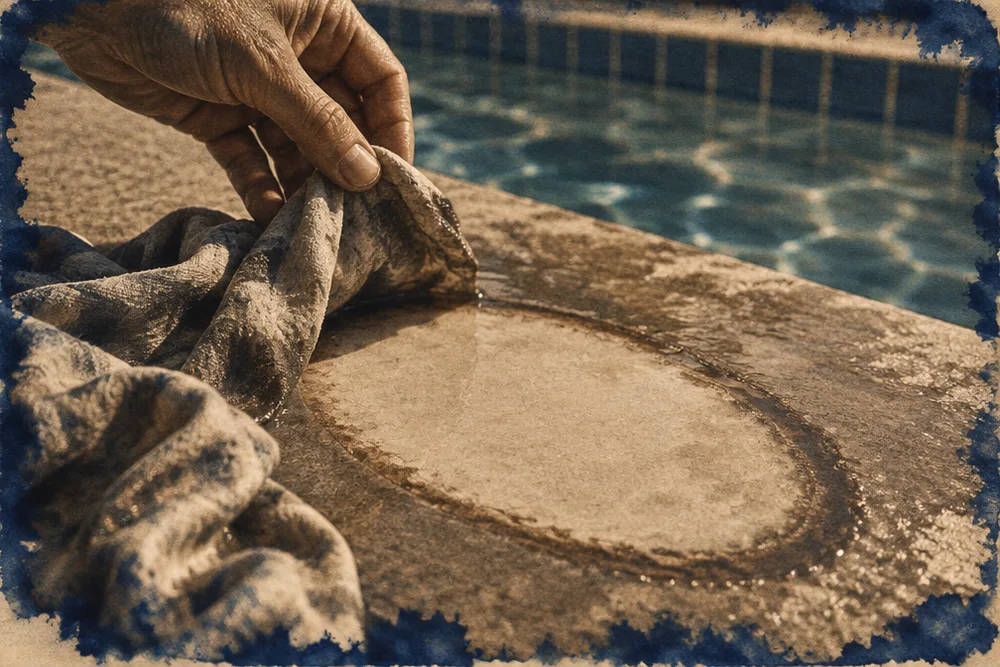
“I’m going to blot the upper one,” she told Basil. “Not wipe it. Just press and lift.” “I heard you.” “If you see anything change, tell me before you move.” “I can do that.” She laid the folded rag lightly over the first wet oval. Its dry fabric darkened immediately. Yvette held it for three seconds, then lifted it straight up. A neat, pale shape remained in the cloth. On the tile, the center of the oval had gone matt and nearly dry. Around it was a narrow, clear outline.
She kept her hand still. “That’s a ring,” Basil said. “Yes.” “Like moisture around the edge.” “Yes.” “Can you smell anything?” “No.” She leaned closer. There was no soap smell, no iron tang, no scent she could name. The dry center was not merely less glossy. It had lost the gray tone of the surrounding wetness, a small island of untouched tile inside a dark rim. She had blotted carefully. The cloth had touched the center as well as the edge.
Yvette set the rag on her knee. The lower print remained where it was. She checked her socks again, pressing each toe to the floor outside the marked area. Dry. A few grains of dust clung to the fabric. She was tempted to press the rag against the second print, to make a comparison. Instead, she laid it beside her and waited. If the wetness had come from a drip, the mark would spread or vanish. If it had come from her own hand, she had just changed it. Neither fact would help until she watched.