The Fourth Tick Went Missing
Page 148 of 270
Chapters
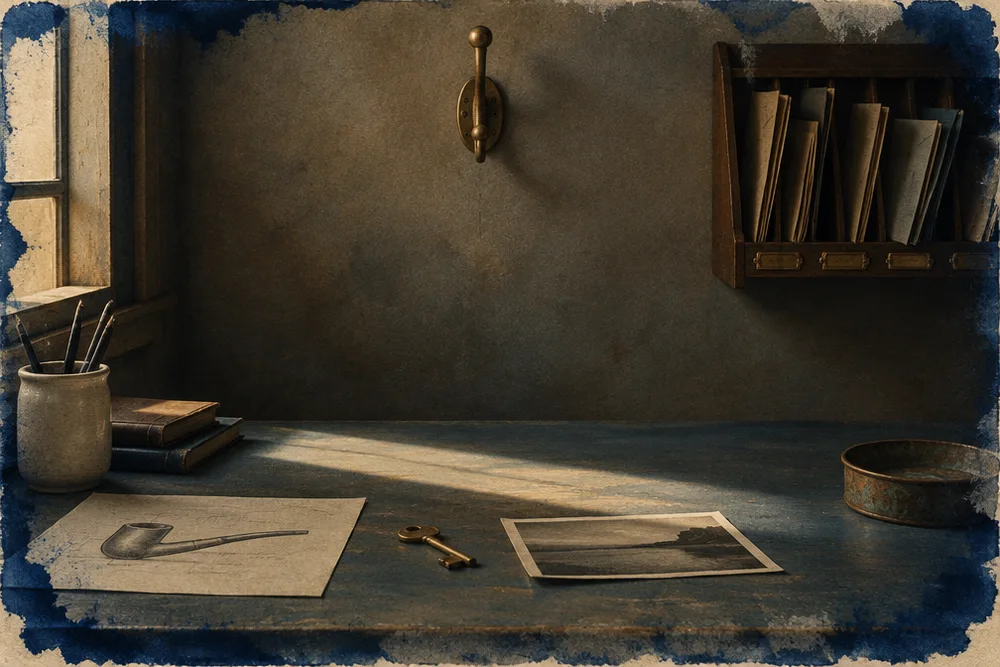
The words did not repair what he had withheld. They made room around it. Yvette placed the key on the desk, between the drawing and the photograph. It no longer looked like a promise. It looked like something that had opened a door, and might be handed over when the shift ended.
A faint sound came from the pool. Not the three quick ticks followed by the pause; not the missing fourth. A shoe sole, perhaps, settling on tile. Yvette’s head turned toward the open office door.
Basil leaned back to hear. He did not count aloud.
The sound did not repeat. The prints in the drained bowl were beyond the office wall, pale and dark in their interrupted sequence. Her mother’s incomplete oval had moved closer earlier, one tile for the tap Yvette had chosen to make. It had stayed when she stopped. The pattern was something she had observed, not an explanation she could carry like a tool.
“I thought it would happen again,” Yvette said.
“Maybe it will.”
“That’s not helpful.”
“No.” Basil’s voice went dry with a hint of apology. “It’s only true.”
Yvette looked down at the photograph’s narrow strip. The names faced up, her mother’s beside hers. She would take the record along with whatever ceramic she managed to save. She would not present the names as proof of reconciliation, or as permission to break the mural. She would give the buyer’s crew the history they had not asked for and the damage they might otherwise misread.
The night still had hours in it. The crew would arrive at six, when her permission to remove ceramics ended with the key transfer. There was time to try the panel, and time enough for the panel to refuse. Yvette folded the pipe drawings around the photograph and carried them toward the pool.
At the pool entrance she stopped. The mural’s swimmer held her turning posture above the deep wall. The displaced ladder’s bolt holes lay two bays west of where the ladder stood now. Near the street exit, the white-sole trail ended at the latch. Yvette’s boots stood beside it, their left toes repaired with the small triangular patches she had put on herself.
The low key hook came back to her—not as a ghostly sign, but as a fact that belonged to an ordinary schedule. Her mother might have expected her to come in. She might have planned a shared job because she had not given up on the possibility. Or she might simply have hung the key where the next worker could find it. The hook did not choose among those meanings.