The Fourth Tick Went Missing
Page 134 of 270
Chapters
“All right.”
He turned with her, slow on his bowed shins. Yvette went first, leaving the wet trail untouched. At the mouth of the service route, she looked back once. The prints still crossed the deck toward the locked door. They had not followed her; they had not vanished. Her departure and her mother’s approach occupied the same night without meeting.
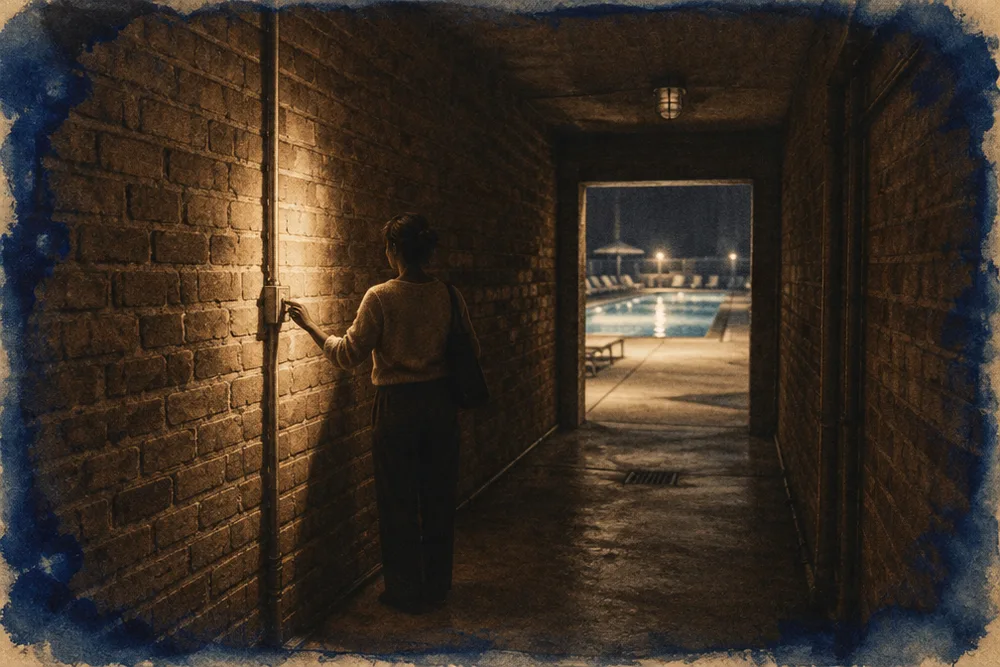
The passage light flickered when Yvette reached the switch. She pressed it once, waited, and pressed again. The bulb steadied in a yellow pool above the brickwork. The Laundry Link smelled of old dust and copper, and the low delivery hatch showed a narrow strip of alley dark beyond it. Yvette checked the bolt without opening the hatch. It held.
Basil leaned against the wall while she inspected the fixture. “You know,” he said, “I used to think the pool only kept what people repeated.”
“And now?”
“I don’t know.” He lifted his good shoulder. “I’m trying not to make a rule out of one night.”
Yvette tightened the loose switch plate with the tip of her key. “That’s sensible.”
“It’s also boring.”
“Most sensible things are.”
She tested the light again. It remained steady. The passage was narrow enough that the salvage board would have to be turned on its edge to pass. Earlier, they had tried it and found the corner would not clear. The whole mural remained too large for the hatch. Nothing about the prints changed those facts.
She could hear the pool from here: the low electric hum, the cooling main behind the wall, the faintest tremor in a pipe. No ticking followed. She had not asked for it. The quiet did not feel like forgiveness, but neither did it demand anything from her.
“When we get out,” she said, “I’m writing down exactly what we saw.”
“All right.”
“Not what we think it means.”
“All right.”
“And I’m putting both names on the photograph.”
Basil glanced at her. “That seems right.”
“It’s not a question.”
“I know.”
She was glad he did not tell her she was brave, or say that her mother would have wanted it. That would have made the photograph into another message from a person who could no longer confirm it. Yvette’s decision did not need a witness to authorize it, though she had one standing beside her.
She switched the passage light off. The darkness beyond the pool had the familiar shape of the service route, not the dense, uncertain dark of the bowl. Her shoulders loosened a fraction. She could move through this space without asking what it remembered.