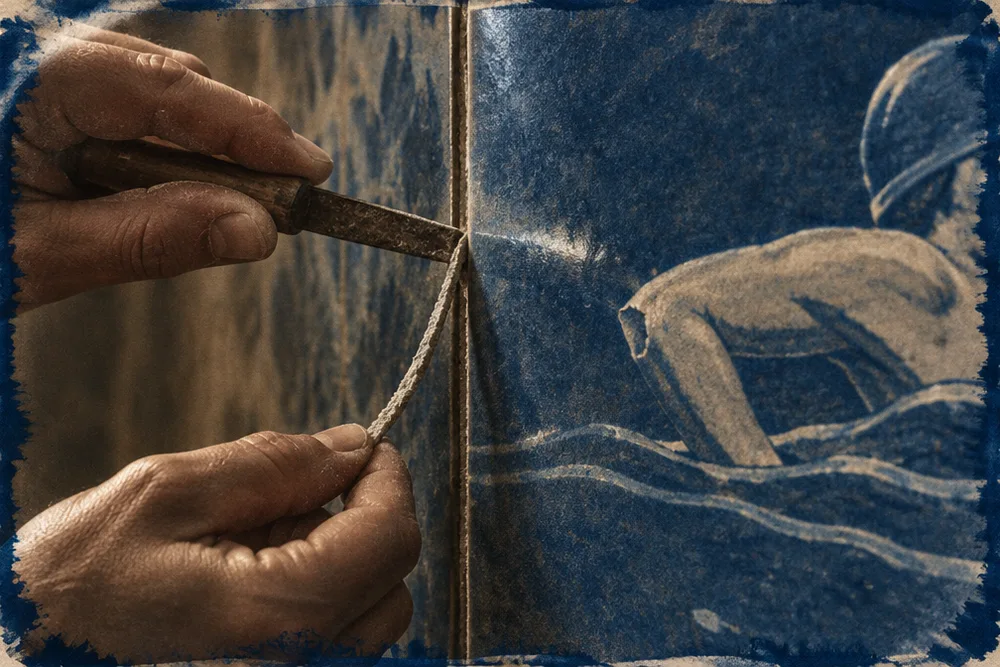
The Fourth Tick Went Missing
Page 116 of 270
Chapters
The lower part of the swimmer’s arm disappeared behind the padding. She moved her head a little and caught the broken blue edge of the elbow again. The wedge was still exactly where she had left it. She wanted to see what, apart from the wedge, was keeping the corner out.
The tile at the elbow was the one she had loosened before the missing tick made her hand stop. Its corner rested against the wedge. Around it, the pale grout held a fine line of dust, and the vertical join divided the swimmer’s reach from the body of the mural. Yvette crouched there, knees stiff, and examined the join from the side.
“I need the scraper,” she said.
“You want me to—”
“No.” She glanced at his wrapped wrist. “Tell me which tray has the narrow one.”
“Number four.”
She fetched it herself. The numbered trays stood in the Heel Room in a row, each meant for a section of ceramic. A shallow bowl of tools rested beside them: scraper, wooden pick, brush, wedge. She selected the narrow blade and returned to the wall.
The grout at the seam was a different color from the rest. Not brighter—nothing here was bright—but less brown with age. A later repair, perhaps. Someone had filled the join carefully, then smoothed the surface until it seemed continuous. Yvette touched the scraper to it and stopped. The blade found a shallow groove beneath the grout, a track running down from the swimmer’s shoulder toward the reach of the arm.
“Basil.”
He came no nearer. “What have you got?”
“A line under the seam.”
“Could be a crack.”
“It’s too straight.”
“Then it could be a cut.”
Yvette angled the blade and worked in short strokes. A thin thread of grout lifted. It came away without the scrape she expected, leaving a narrow, clean shadow beneath. The groove ran precisely along the join.
Yvette set the blade down and used the wooden pick. The point slipped into the groove without force. She traced it a few inches, then stopped where the grout thickened. There, beneath the surface, the cut turned around the elbow tile and continued downward.
The mural had not been made as one unbroken field. It had been given a break line. Hand-cut, not the even seam of a factory tile. The irregularity was slight but deliberate, a shallow score under the grout that could guide a separation if the wall ever needed repair.
“It goes around the elbow,” she said.