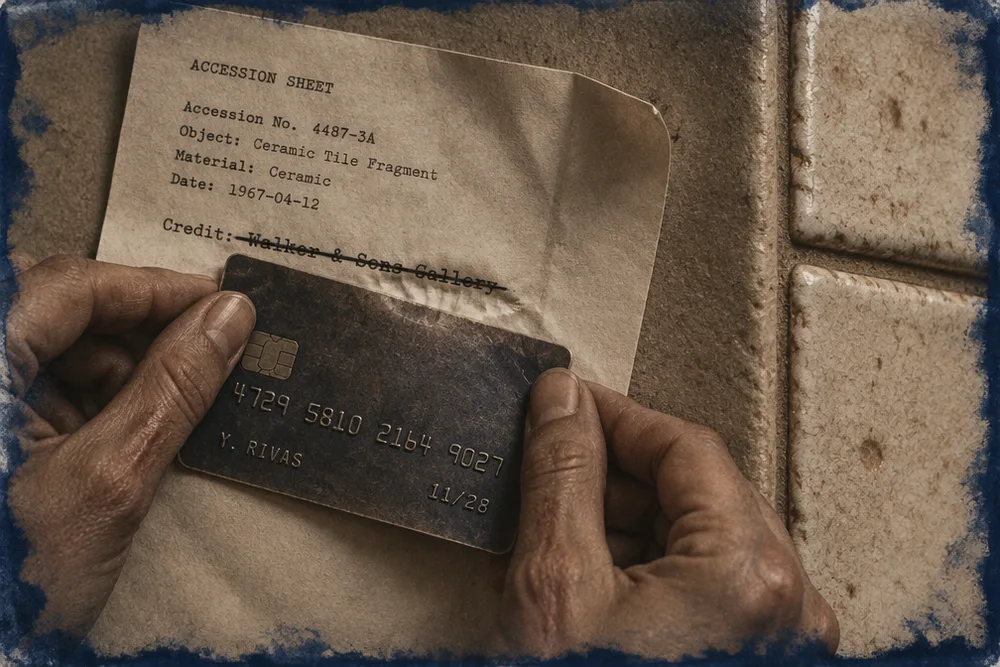
The Fourth Tick Went Missing
Page 110 of 270
Chapters
“That one,” Yvette said.
Basil stepped closer, then stopped at the edge of the board. He did not ask to hold it. “I remember the committee arguing over the wall.”
“You remember the pipes.”
“I remember what was said while I worked on them.” He leaned his head back a fraction. “There’s a difference.”
Yvette turned the form over. The back was blank except for a blue pencil mark, a short slash through the paper. It might have been a correction. It might have been the start of a name. The slash was placed where another signature could have fitted.
The form stuck to the accession sheet where a ridge of old paste had dried. Yvette eased it free with the flat of her thumbnail. The next layer was not paper but a small card, folded down the middle. Its surface had gone the color of weak tea, and the crease had nearly split through.
A printed heading showed when she opened it: ARTIST’S CREDIT. Beneath it, a name had been typed and then struck through. M. Jowett remained legible under the black line. A handwritten note followed in a narrow, hurried hand: declined joint listing; retain wall space under one name. The letters crowded the margin, as if whoever wrote them had been short of time or reluctant to make the words fit.
Yvette stopped breathing for a moment. Then she drew in air through her nose, tasting dust and cold pool water that wasn’t there.
Basil’s eyes went to the card. “That’s not the copy I saw.”
“You saw a copy?”
“Years ago. I brought the drawings back once and was asked to look at the pipes, not the paperwork.” He put his left hand against his cardigan. “I didn’t know there was a card.”
“But you knew the committee wanted one artist.”
“Yes.”
“You knew my mother took it.”
“I knew she signed.”
“Not the same thing.”
“No,” Basil said. He did not look away. “It isn’t.”
Yvette laid the card flat. Its black strike-through crossed the name with the blunt certainty of a line drawn after the argument was over. She wondered how long it had been hidden behind the record that claimed the mural was unsigned.
The deck around them held its late-night cold. The pool was drained; the damp smell belonged to old grout, old pipes, the black seam where wall met floor. Overhead, the spectator balcony waited empty. Heel dents in its boards caught a thin wash of light. The old laundry workers had stood there before their lesson slots, watching club swimmers take the water first. Then, in the gap between one group and the next, Yvette and her mother had painted the blank tiles.