The Fourth Tick Went Missing
Page 10 of 270
Chapters
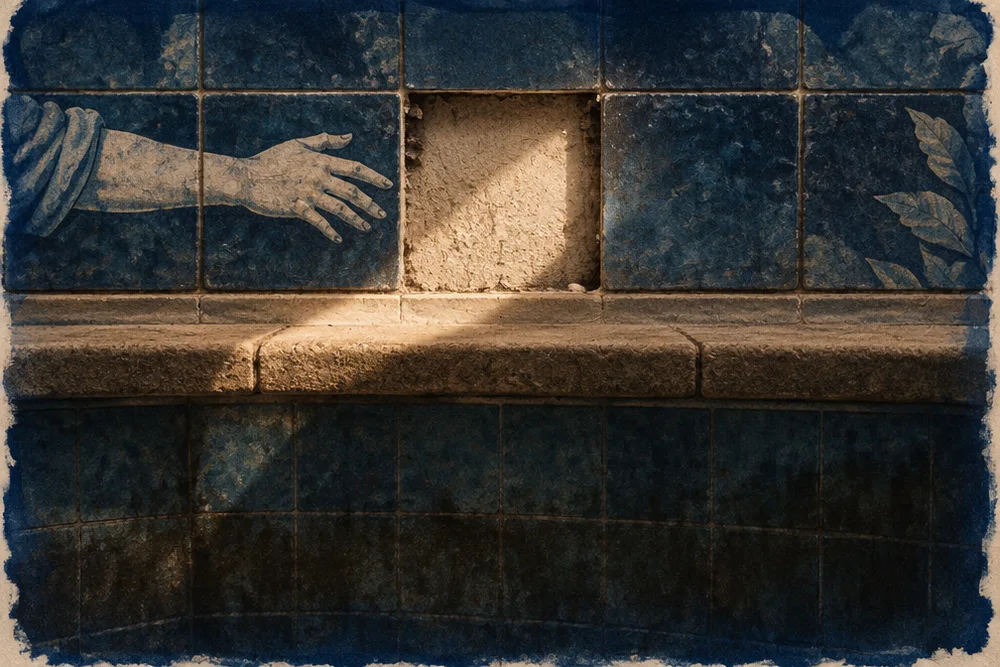
Yvette checked the tile’s back for old adhesive and found nothing unusual. It was a cheap blank ceramic, thinner than the mural’s outer pieces, with a pale square of mortar clinging to one edge. She set the tile in the tray and laid a cloth over it. The mural’s painted elbow now had a narrow gap at the top, barely large enough to show the rough wall beneath.
She recorded the time on the tray label. Then she checked the permission sheet again, though the words had not changed. CERAMIC ELEMENTS ONLY. The phrase seemed designed to tell her what could be saved and nothing about what saving it meant.
Basil folded the pipe drawings and rested them on the office desk. “I’ll stay until you’re ready to try the next one.”
“You don’t need to stay.”
“I brought the drawings. I can help.”
“The board won’t turn.”
“Not through the Heel Room.”
“And the Laundry Link is too low.”
“Probably.” He leaned back, listening to the building. “Maybe there’s another route.”
“There isn’t.”
“You’ve looked?”
“I’ve worked here thirty years.”
He accepted that, but his gaze drifted to the board propped by the wall. Yvette knew what he saw: a long, rigid thing built to preserve an unbroken piece of work, trapped by an old building’s narrow turns. She knew what she saw too. The board had to work. The mural had to leave in one piece. She had repeated those conditions to herself until they seemed like the same condition.
Basil picked up the lamp. “Do you want me to check the street door again?”
“No.”
“The mark, then?”
“No.”
He set the lamp down. “I won’t do either unless you ask.”
Yvette was grateful for the offer, and for the way he made it without making her answer. She walked to the mural and put her fingers beside the gap. The tile had come away cleanly. The next one would take more work; its grout seam was narrow and the painted curve crossed the joint. She had to find the place where the wall would agree to let it go.
The three quick ticks sounded again behind the deep wall.
Yvette’s hand stopped. The pipes paused.
She did not count aloud. She had never needed to. The pause lengthened, empty of the last sound. Basil’s head tilted toward the wall, but he did not speak.
At the deep end, the wet heel darkened against the pale floor. Its edges sharpened, as if the moisture had just settled there.
“It’s getting darker,” Basil said.
“The mark?”
“Yes.”