The Empty Chair Was Yellow
Page 71 of 153
Chapters
Her phone vibrated on the island. A message from her cousin: Mum’s story is so lovely. Send the recording when you get a chance. There was a yellow heart after it. Tessa imagined replying with the difference between the sentence she had made and the sentence Idris had spoken. She imagined the cousin reading it as an argument, then saying she had only meant to be kind.
She put the phone on silent. The recorder was in her coat pocket, its padded case pressing against her hip. She had not turned it on since Idris’s review. The approved account he was shaping belonged to him; she had no right to use its most affecting phrase as a patch over the family’s unease. Yet she could hear his hesitation too: the slight pause before he said he had seen June sit, the careful distinction between what he saw and what he could infer.
The story had once seemed to Tessa like a neatly kept object, something June had passed down intact. It had survived in family kitchens and anniversary copy, gaining the smoothness of repetition. She had been proud of that smoothness. Now, with the machines gone, she could see the fingerprints in it: hers, and those of people who had been trying to say what June meant to them.
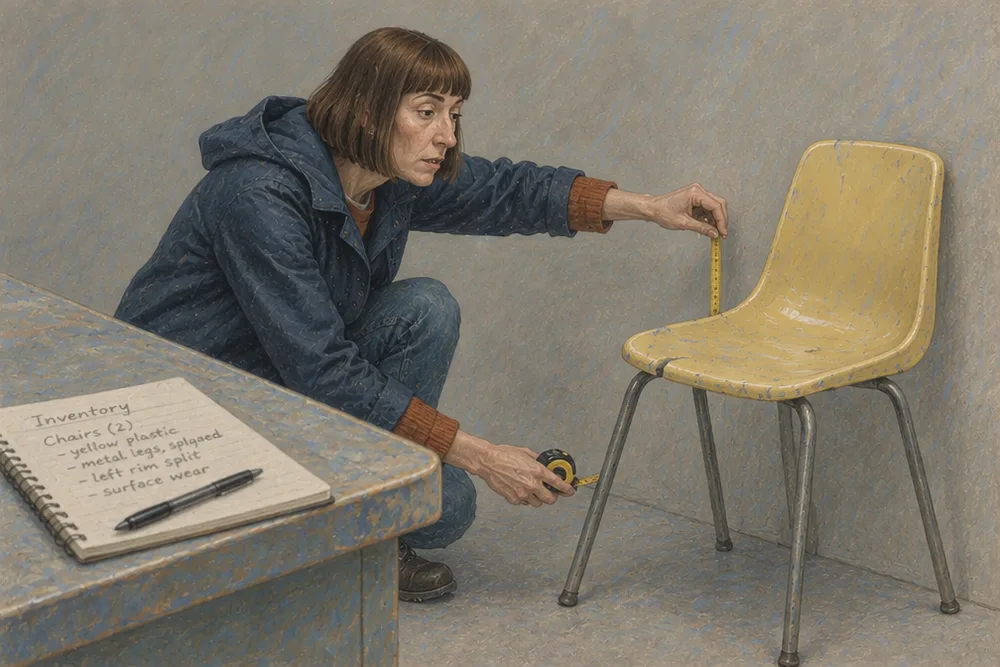
She took the chair’s dimensions with Nell’s tape measure. Seat, back, legs. The pencil left a gray line on the inventory. Under description, she wrote yellow enamel chair, split left rim, four splayed legs. No provenance. Nothing about the flood.
The stockroom held more than the shop could plausibly have needed: detergent cartons with the corners softened by damp, empty jars saved for buttons, rolls of till paper, a tin of spare screws, and a row of old appliance manuals June had never thrown away. Tessa opened each box and wrote what was inside. She kept the labels plain. Socks for charity. Cleaning cloths. Assorted fixings. The work steadied her because nothing in it required her to decide what a person had meant.
At the back of the second shelf, she found a cardboard sleeve with a family photograph tucked inside. June stood in front of the shop, younger than Tessa remembered her being at the flood, one hand on the doorframe. The other was hidden by the angle of the print. Behind her, the yellow chair was just visible through the glass, its color dulled by reflection. Tessa did not take the photo out. It was already listed among the papers upstairs, and she had learned that moving an object merely to look at it could start a new round of questions.