The Empty Chair Was Yellow
Page 35 of 153
Chapters
Ruth found the passage. “‘June Gleave pulled a yellow chair up for the one customer still on her feet.’” She looked up. “That’s your mother’s version, is it?”
“That’s how I remember it.”
The sentence had a settled sound, a sentence shaped to travel. Tessa had used something close to it in the shop’s twentieth-anniversary caption, though she couldn’t recall now whether she’d written “still standing” or “still on her feet.” The caption had been on a card beside the till, then on a photograph in the local paper’s online gallery. She had drafted it after June complained that she couldn’t think of anything to say about herself. Tessa had thought a daughter could do the thinking for her.
Ruth turned the page. “He says he heard it from your mother?”
“I don’t know.”
The second account was a letter, written years later by a woman who had lived above the chemist. The pages were thin, the ink faded to brown. Ruth leaned over it, following with one finger. The woman described a crowded shop, wet coats steaming, the dryers rattling, and June “bringing out the yellow chair for the last person standing.”
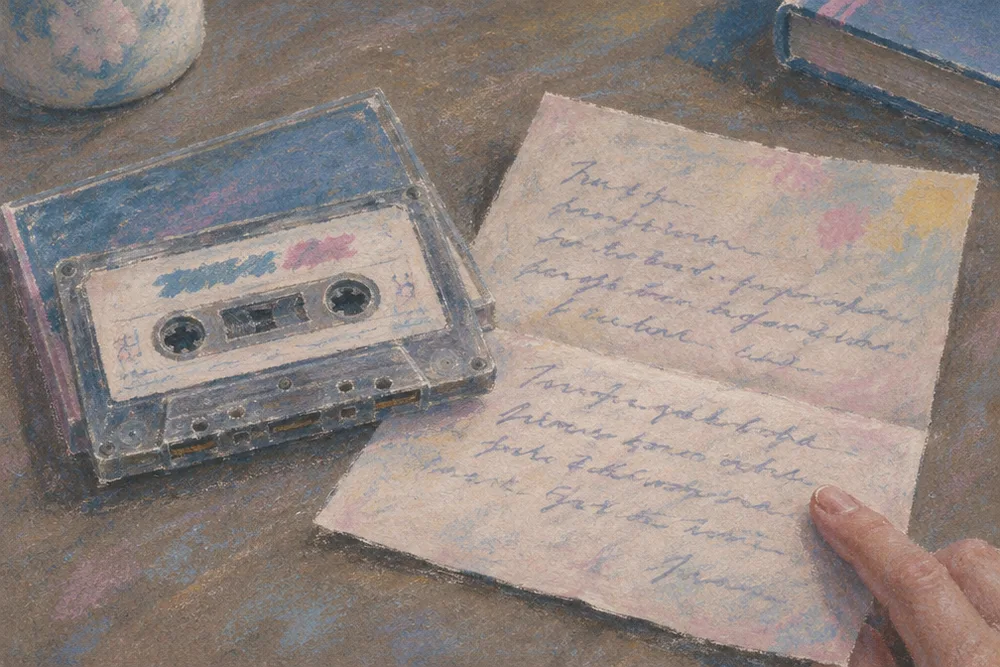
Tessa watched the words. The chair’s color had always seemed the least disputed part. In the shop it had been impossible not to notice: chalky yellow enamel, a split in the left rim, the legs splayed a little wider than they should have been. Yet the exact wording of the gesture had followed it everywhere, the chair offered as if the color itself confirmed the hand that moved it.
“This one’s dated six years after your anniversary piece,” Ruth said.
“That doesn’t mean she read it.”
“No.” Ruth’s voice was even. “It doesn’t.”
The letter’s writer had been at the end of the shop nearest the folding island, according to the next paragraph. The chair, as Tessa knew from the layout, stood by the counter, beyond the view from the service lane. The writer might have seen it. She might have heard about it afterward. Tessa had not asked that question when she first read the letter.
The third account was a short recollection on a form from the town’s flood anniversary project. Ruth had to retrieve it from a box marked STREET MEMORIES, where it had been filed between a photograph of sandbags and a note about a flooded cellar. The handwriting belonged to someone Tessa knew only as a surname, Kersey. It was a single paragraph, typed up by a volunteer and signed at the bottom.