The Empty Chair Was Yellow
Page 128 of 153
Chapters
On Monday, she carried the folder to the library and left the chair at home. The building’s lending floor was busy with schoolchildren returning books and a man asking at the desk for help with a printer. Tessa waited at the local-studies counter while Ruth finished with another visitor. She could see Ruth’s high puff above the shelves, her lilac cardigan moving as she crossed the room.
When Ruth came over, she had the deposit forms ready. “Did the handover go all right?”
“Yes. We surrendered the keys at noon.”
“And the chair?”
“At home.”
Ruth nodded, as if this were the expected answer. She turned the forms so Tessa could check the names and permissions one last time. Idris’s account was credited to him, separately. Tessa’s daughter’s recollection was described as just that. The third track was listed in Tessa’s own name. There was no line declaring which account corrected another.
“You can take these away if anything feels wrong,” Ruth said. “Nothing becomes part of the catalogue until each depositor has signed.”
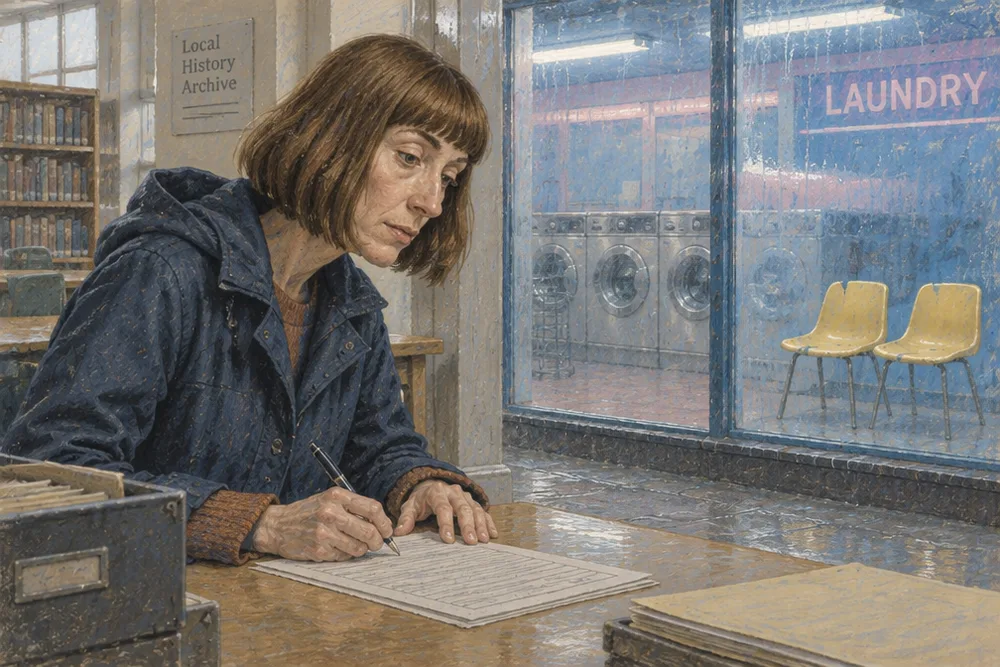
Tessa read each page slowly. In the description field, the words were plain and unadorned. Her mother’s account arrived through her daughter’s memory. Idris’s arrived through his own recollection. Tessa’s track spoke about listening, family, and the chair. The three recordings could be found together, but no single voice spoke for the other two.
She signed her forms. Idris’s was already signed and held under its own permission. Ruth checked the signatures, made copies, and returned one set to Tessa. “We’ll contact you before the listings open.”
“Thank you.”
Tessa put the copies in the folder. A child behind her asked their parent whether the local history room had old maps. Ruth turned to answer. Tessa stepped aside, making room at the desk.
Outside, she walked home rather than taking the bus. The route passed the laundrette’s street, and she paused across from the glass front. A paper notice had been taped inside. The room beyond it was bare, its fluorescent tubes off. The chair was not there. It had no reason to be.
She did not look for a sign of June in the window. The shop was not a shrine, and its absence did not undo the work that had happened there. Tessa turned toward home and continued walking. In her bag, the signed copies rested against the meter receipt. At home, she would put them away with the family photographs. The chair would still be in the hall, yellow in the afternoon light, holding its own place without needing to prove how it had come to be there.