The Colander Between Two Doors
Page 169 of 223
Chapters
Tess laughed. In the picture his mouth had just begun to pull to the right. She liked it better than the smile he might have held for her if she’d asked him to. She turned the screen off and slipped the phone into her pocket.
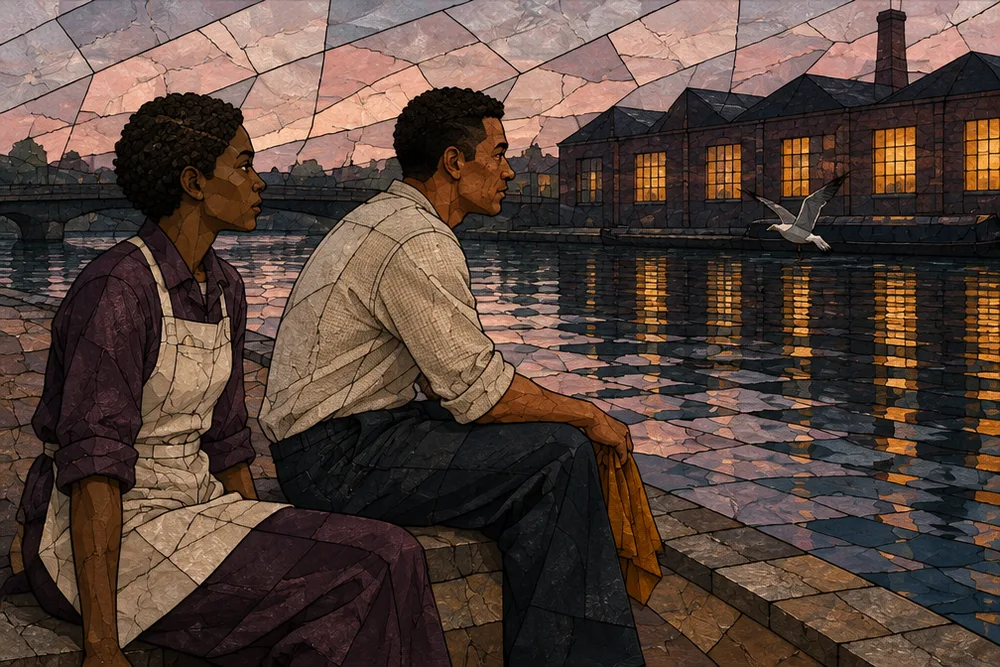
Will sat back, his hands braced on the brick on either side of him. From the far bank came the clack of a loose drain cover as somebody wheeled a bicycle over it. Tess followed the rider past the last loading bay and out of sight. The strip of light had left Will’s sleeve.
A gull came down near the water, considered the path, and lifted away again. The light had shifted toward evening. Across the canal, a few windows glowed amber against the pink-gray sky. Tess felt the cold working through the brick beneath her. She could have stood. She could have asked him to walk her home. Neither choice had to mean anything more than itself, but she was beginning to notice how quickly she tried to make choices carry a whole future.
“Do you want to head back?” Will asked.
“Not yet.”
“All right.”
They stayed. His shoulder was a hand’s width from hers. The space held without being filled. Tess thought of the two chairs in her flat, the cleared table, the food she had not yet bought. If she invited him, he could say no. If he said yes, he would be there because she had asked and because he wanted to come, not because a supper needed another pair of hands or a bowl needed a home.
The thought tightened her stomach. She let it.
“I moved the sewing off my table this morning,” she said.
“That’s a brave thing to do. What’s it for now?”
“Eating, I think.”
“You think?”
“I’m still getting used to the idea that a table can have one job at a time.”
“They’re surprisingly good at it.”
“You sound like you’ve made a study.”
“I have a table that is technically a bed obstruction. I’ve had to consider its uses.”
She laughed. “You measured it for Nell’s table.”
“I measured the table for the space. The bed was already there.”
“And you stopped offering to keep it when you saw where it would go.”
“I couldn’t put it in the only place I can sleep without climbing over it. That would have been a bad invitation to regret.”
She liked the carefulness of that answer. It was not that he had refused the table or the memory attached to it. He had refused to pretend that taking it would be costless. The table had gone to the reuse depot. The memory had not gone with it.