The Breathing Wall on Floor Minus One
Page 41 of 202
Chapters
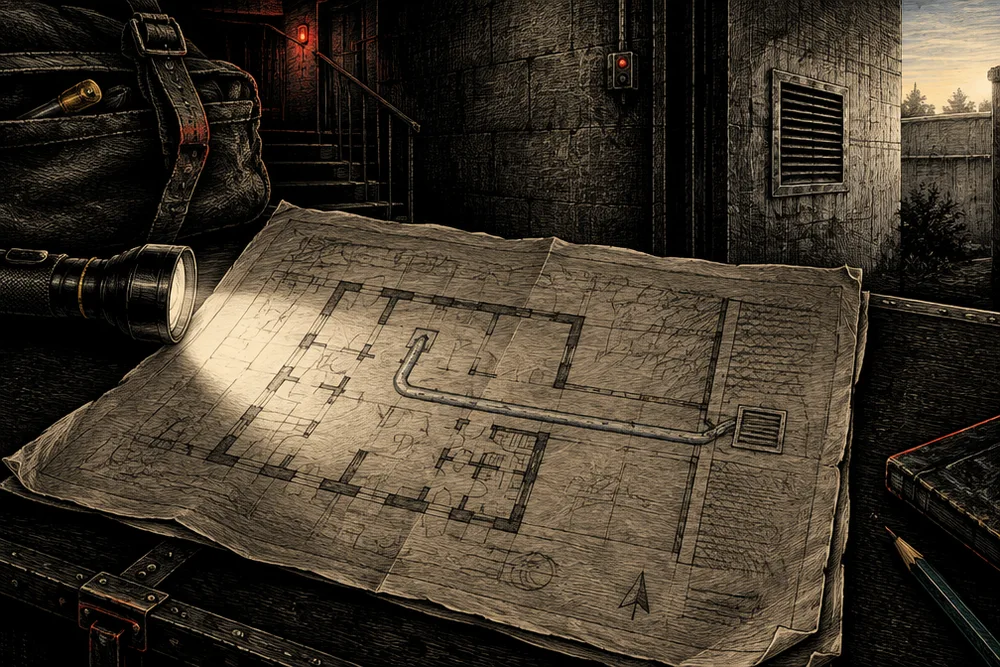
He pointed to a darker stroke laid over the original route. “Here. They built it across the passage and closed the gap. I don’t remember who made the decision. I remember signing a work sheet saying the wall was finished.”
Gilda looked at him. “You were caretaker?”
“Before you. I did not know what the wall was. I thought it was a wall.”
The words were simple, and their honesty left her no comfortable reply. Ivo’s old sketch had the same cheap paper feel as the photocopies she had found in the board office: corners curled, ink faded. The mark for the vent was just a square and an arrow, hardly more than a child’s diagram, but it aligned with the basement wall and the exterior grille she had seen from the court.
Mara pointed to a narrow line drawn beside the vent. “What’s this?”
“A grille,” Ivo said. “Iron. It was always clogged with lint, but it could be cleaned.”
“Was it open when they partitioned the passage?”
“For a while. They sealed the room side. Not the outside grille. The passage still had a little air through cracks.”
Gilda felt the damp chill of the court through her coveralls. “Then later repairs sealed those cracks?”
“That is what the marks say.” Ivo tapped the dates. “Each time the route narrowed, someone lost something. Not always the same kind of thing.”
“What did you lose?” Mara asked.
Ivo turned the pencil between his fingers. “My daughter’s laugh.”
Neither Gilda nor Mara moved. A droplet fell from a drainpipe and struck the concrete near Gilda’s boot. The small sound was sharp enough to seem deliberate.
“She died?” Mara asked.
“Many years ago. She was grown, with a child of her own. I did not lose that she had lived, or what happened. I lost the sound of her laughing.” His mouth shifted, not quite a smile. “I could remember how it made the kitchen feel. I knew I had once heard it. But when I tried to call it up, there was only the knowledge that it had been there.”
Gilda thought of the things she had lost without knowing their names. Her mother’s last evening was a blank interval she had never thought to question. She knew her mother had been ill; she knew she had gone home after visiting. There was no remembered parting, no last sentence, no particular light in the room. She had taken the absence for grief, then for time. The repair she had signed off on three winters ago had been a simple patch beside a basement seam.