The Breathing Wall on Floor Minus One
Page 38 of 202
Chapters
“This is not on the current plan,” Gilda said.
“No,” Ivo replied. “It was not on the plan when I started keeping this, either.” He flattened the paper with his palms. “The wall went up twenty-four years ago. Before that there was a passage to the vent. Laundry heat, damp, soap smell. You could stand here and feel air move through the bricks.”
Mara leaned over the sketch. “What did the passage connect?”
“Laundry room to the back court. A vent throat, not a door. The partition cut the passage in half. They said it was for storage and fire separation.” Ivo touched the penciled line with one bent finger. “The first airtight repair.”
Gilda had spent the morning matching invoices to the layering in the basement wall. She had not told them the details yet; she needed to see whether the ledger would match what she had found, or whether she had begun arranging scraps into a frightening story because the wall had breathed at her.
She opened her notebook. “I have three repairs that might be the same crack. One from the year the partition went in, one later patch, and the job I signed off on three winters ago.”
“Read them,” Mara said.
Gilda turned to the pages. She had copied the terse descriptions, the dates and the amounts. “Partition sealed at laundry passage. Plaster and lath, two laborers. Then, nine years later, a seam repaired at the west return. Then my patch: hairline movement, basement corridor, skim and paint.”
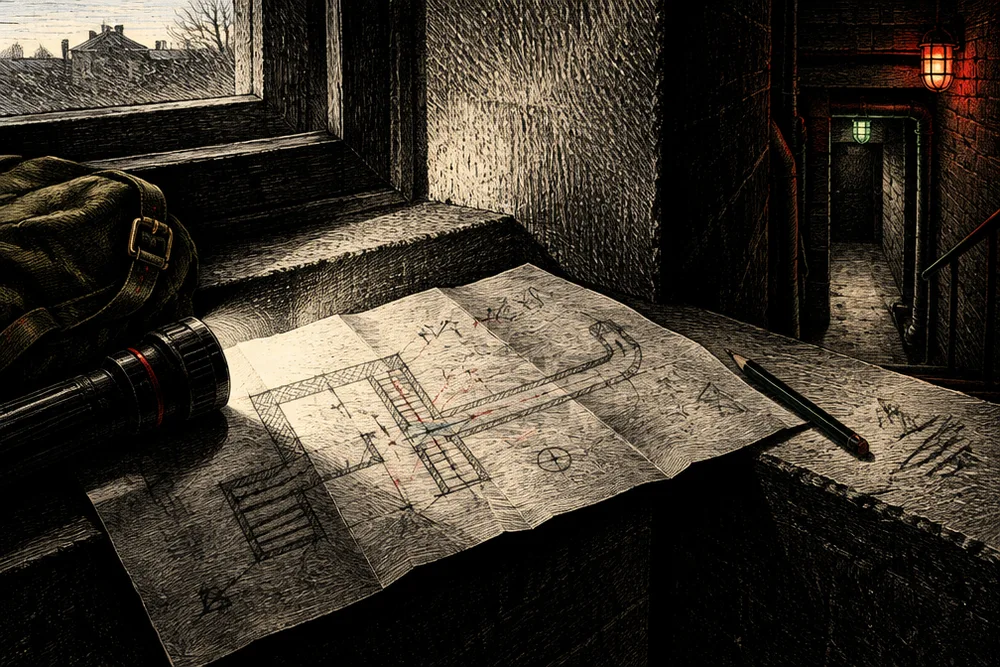
“And beside those?” Ivo asked.
“Tenant records. Emergency contacts changed. A leaseholder request to remove a name from the directory. No explanation.”
Ivo’s eyes stayed on the sketch. “That is where I marked it.” He reached into the inside pocket of his vest and took out a pencil, worn almost to the ferrule. On the paper, small marks gathered beside the partition line. They were not names. They were short slashes, each set beside a date.
“I used marks instead of names,” Ivo said. “At first I thought a name would make it worse. Then I thought the marks would make it easier to keep straight.”
“Keep what straight?” Mara asked.
“What people had lost.”
Gilda looked from the marks to the entries in her notebook. The same dates appeared in both places, within a day or two of the repair invoices. The first slashes were clustered around the year the passage had been closed. She had expected a pattern to look persuasive. This one looked small and bureaucratic, the sort of thing that might hide for decades in a cabinet because no one had reason to search for it.