The Breathing Wall on Floor Minus One
Page 32 of 202
Chapters
She returned to the cabinet and searched by reference number. A repair three winters old had been filed under water ingress. The contractor’s note said the lower seam had been patched after a leak from the laundry standpipe. Gilda remembered signing the completion sheet. Her mother had died that winter. She remembered a phone call in the caretaker’s office, the funeral clothes hung over the radiator, and a cup of tea gone cold beside the forms. The last evening with her mother was a blank shape she had long ago learned not to prod.
The invoice specified a quick-setting compound, two coats, and a sealed finish. Her own signature sat at the bottom, pressed through the copy beneath. She checked the date twice, though there was no mistake. The work had been done on a Thursday. The next morning she had gone to her mother’s flat to sort the cupboards, certain that she had already said goodbye in the right way. She could remember her mother’s hands, the chipped blue bowl, the smell of boiled wool. She could not remember the final evening.
Gilda shut the binder. Memory and maintenance were not interchangeable words, she told herself. A signed work order proved only that she had inspected a patch. It did not prove anything had been taken. Still, the old invoices made a chain: partition, skim, seal; leak, patch, seal; each repair tight against the one before. She carried the binder back to the wall and used the screwdriver tip to lift a flake at the edge of the newest plaster. Beneath it, a gray layer showed through, crossed by a thin chalk line.
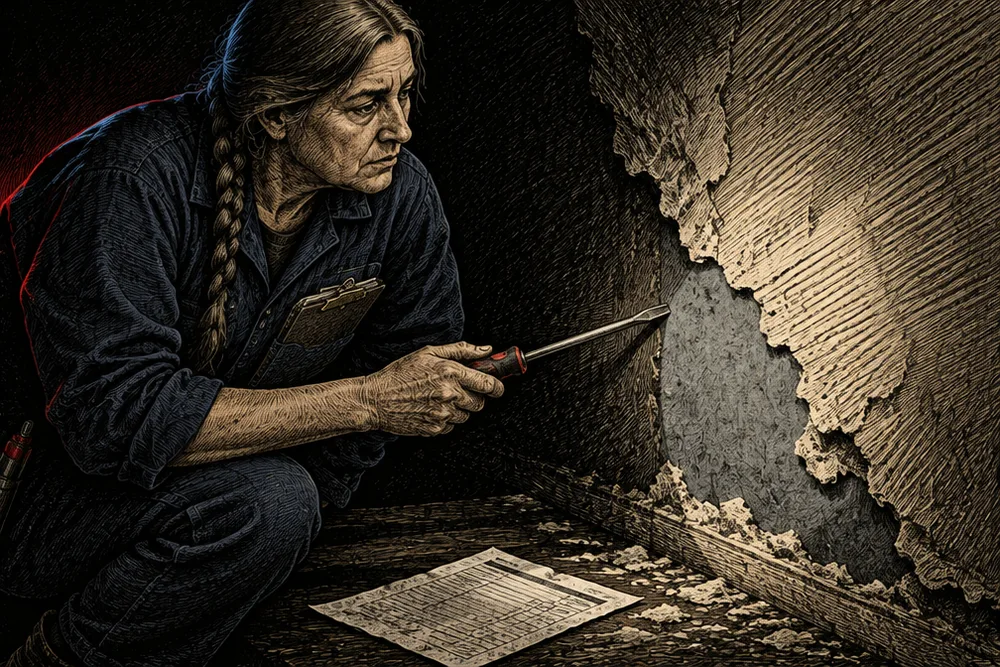
The chalk line ran horizontally at knee height. Gilda followed it with the ruler, measuring from the corner to the point where it disappeared under the newer coat. The work order for the three-winter-old patch gave the length of the seam: one metre and forty centimetres. Her measurement came to one metre and thirty-eight. Two centimetres were not enough to make a mystery. They were enough to make her write the figure down.
She found another invoice for a repair eight years earlier, a crack above the old laundry sill. The description said the opening had been filled with mortar and finished flush. The caretaker then had been Ivo Dace. His signature was a long, sloping scratch, too faded to read unless she tilted the page toward the bulb. Beneath it, a clerk had written: tenant notified; no access required. There was no tenant name, only a small mark like a bent hook in the margin.