The Breathing Wall on Floor Minus One
Page 197 of 202
Chapters
She had begun to understand how much work it took not to turn fear into a false certainty. A clean log could still record a bad decision. A sealed crack could still be a cost passed to someone who had no idea it had been paid. Now, when she wrote “repaired,” she added how, and by whom, and what had been left open.
At the sixth floor, Gilda checked the roof hatch and tested the alarm. Mara waited near the stairs, coat folded over one arm. The inspection took long enough for the building’s small noises to gather around them: plumbing knocks, a door closing, footsteps crossing the unit overhead. Not a breath, exactly. Just the ordinary working of a place inhabited by people who had agreed to listen.
They descended together. On the second floor, Mara asked whether Gilda thought the building remembered them. Gilda looked at the handrail, its varnish dulled where hundreds of palms had worn it thin. “I think it keeps what we leave in it,” she said. “That isn’t the same as remembering.” Mara considered this, then said she preferred the distinction. Gilda wrote it nowhere. Some things needed no box on a form.
At the basement door, Gilda unlocked the new latch. The old one had been removed after the evacuation, when the residents agreed that no one should be able to close the route to the court without everyone knowing. A bright red tag hung from the handle. OPEN PASSAGE—DO NOT OBSTRUCT, it said. The words were large enough to read from the stairs.
Mara stopped at the threshold. “I don’t like basements,” she said. “But I don’t want not knowing to be the price of avoiding one.”
“You can wait upstairs.”
“I can,” Mara replied. She followed Gilda down anyway.
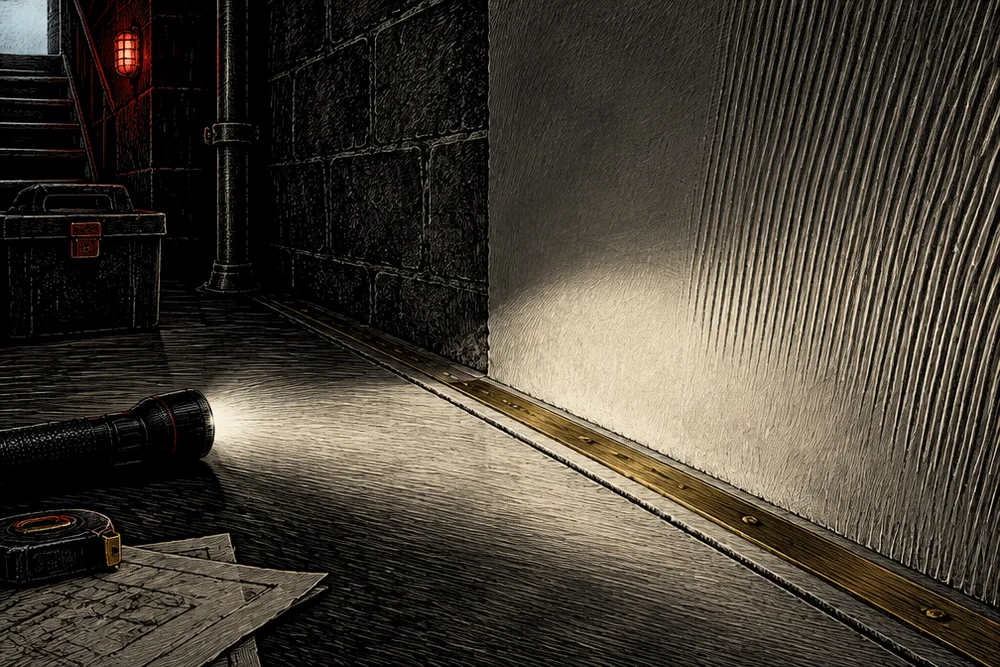
The corridor had been altered without being made pretty. The partition that had once cut across the old laundry passage was gone. Its former line remained as a difference in the floor: newer cement meeting older stone, a pale strip where the raised sill had been exposed. The wall that had swelled into the corridor had receded, though its surface remained unnaturally smooth, the plaster marked with shallow parallel grooves so the eye could measure its plane. A strip of brass set into the floor recorded the furthest point it had reached.
Gilda had helped Kit install the marker. They had measured from the same painted line each time, checked the tape against the brick joints, and photographed the result. The brass strip was not a charm. It was not even a barrier. It was evidence, and evidence was the most useful thing she knew how to leave behind.