The Bench on the Moving Truck
Page 91 of 152
Chapters
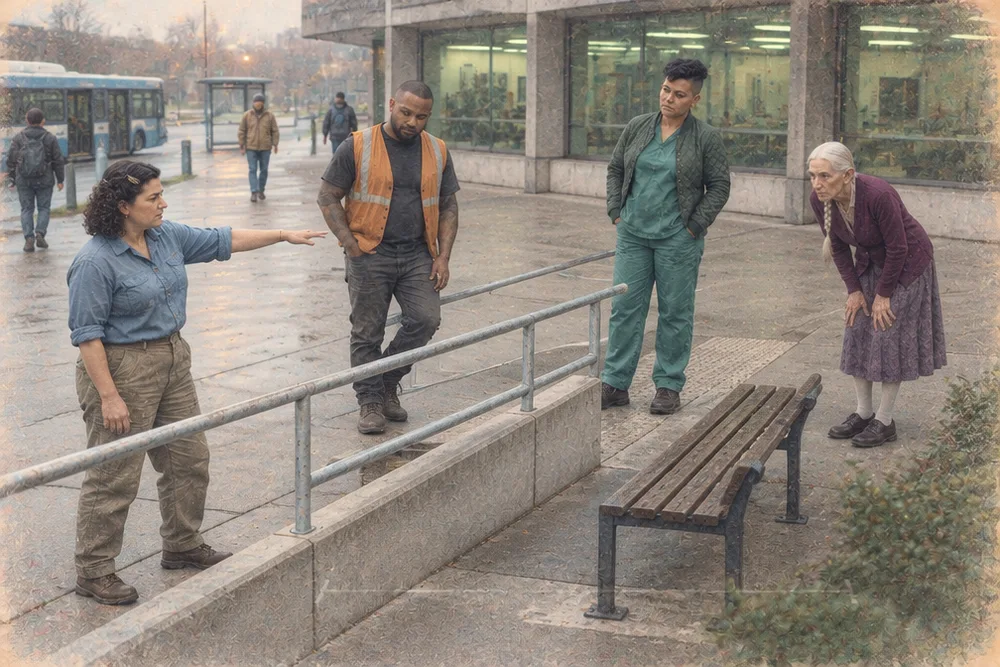
“That’s where everyone puts benches,” the manager said.
“That doesn’t make it accessible,” Inez replied.
He did not argue. He glanced at his clipboard, then at the bus pulling up. People began to gather beneath the overhang, leaving a narrow channel along the tactile strip. The forecourt had seemed empty until it had to be used.
A woman with a folded umbrella maneuvered her wheeled shopping trolley past them. The trolley’s front caster caught on a ridge in the paving, and she had to pull it back and angle around the group. Lenora stepped aside. The woman made the turn, reached the bus stop, and stood with her back to the library wall.
The manager watched her go. “We can put the bench farther out.”
“Then it crowds the queue,” Omar said. He held the tape measure taut across the paving. “And we’re not anchoring anything until you tell us where.”
Lenora crouched to inspect the landing’s edge. A narrow strip of textured paving ran parallel to the curb, leading toward the bus stop. She had learned to look at a place from the height of its obstacles: the lip of a curb, a loose stone, a door that swung into the only clear path. The ramp landing was a small square of open ground, necessary precisely because it looked like unused ground.
A man carrying a paper cup came up the ramp. He stopped at the top to let a child in a yellow jacket pass, then turned his chair in a compact, practiced arc. His front wheels skimmed the edge of the chalk mark on the paving. The manager shifted his clipboard out of the way. Lenora watched the man complete the turn without touching the rail, then watched him move along the wall toward the doors.
“What about here?” Malik asked. He pointed to the wall beyond the library’s exterior book-return slot, on the other side of the ramp. A rain gutter descended there, its drain opening a few feet from the paving.
“That would leave the landing alone,” Lenora said. “But we need to check the queue.”
They measured again. A bench placed parallel to the brick wall would preserve the ramp’s turning space and leave a route from the bus stop to the door. It would sit close to the book return, though, and the manager worried it would block a person carrying a stack of books. They shifted the proposed position, then shifted it back, marking each candidate with a stub of chalk.