The Bench on the Moving Truck
Page 2 of 152
Chapters
Ada carried a folder pressed flat to her chest. She was seventy-seven, Lenora guessed, though the face was difficult to read: long and diamond-shaped, with prominent ears and a mouth set in the patient line of someone accustomed to waiting for other people to finish. “The three feet are already on your estimate,” she said. “It seemed simpler than making a separate call.”
“You’ve paid for the space,” Lenora said. “That doesn’t tell me where it’s going.”
“No.” Ada opened the folder. Inside were the residents’ association release, a typed inventory, and several sheets of lined paper covered in names and phone numbers. The release was signed by three officers and stamped with a faded blue circle. “It belongs to the association. The association voted to let it go. It cannot stay after tomorrow.”
“Let it go where?” Omar asked. He glanced at the bench, then at the narrow truck ramp. “It’s heavier than it looks.”
“That is why I paid for the space.” Ada spoke without sharpness, which made the words land harder. “I asked people. They have their own moves. Their own storage. Their own arrangements.”
From the bench, the man lifted his cup. “I can take it,” he said. He was maybe sixty, in a coat too thin for the weather. “If somebody gets it down the steps and onto my cart.”
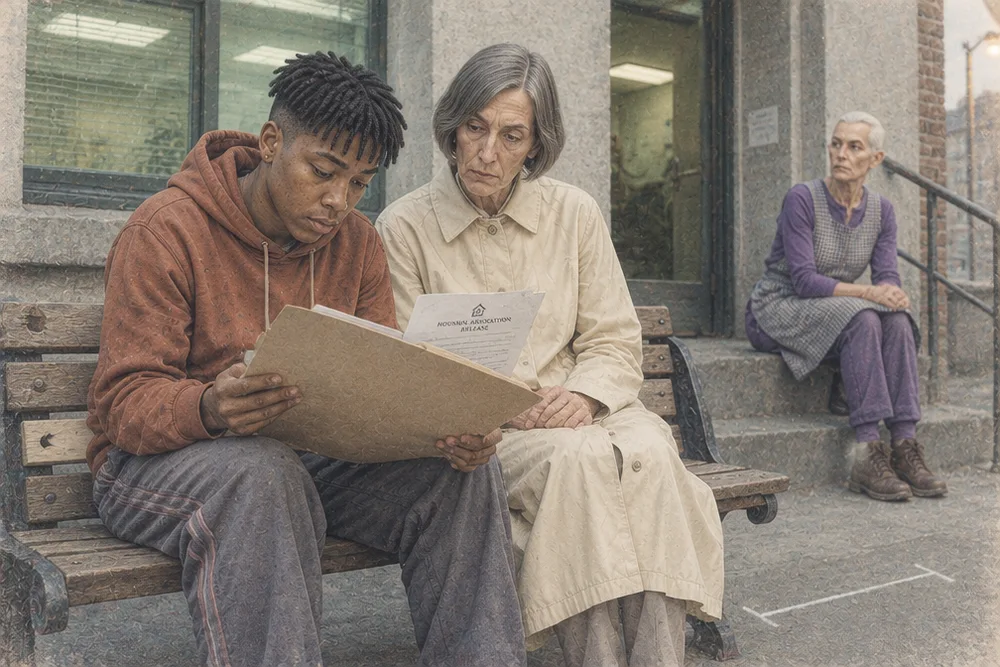
A voice from the doorway behind Ada said, “He can’t keep it where he’s going.” A woman in a cream raincoat had come down the hall. She was tall, narrow-hipped, her gray bob cut straight at the jaw. Her neck seemed to hold the rest of her rigidly upright. Lenora recognized her from the building’s file as Ruth Sayer, former tenants’ liaison. “I called the storage place. They won’t accept outdoor furniture.”
“Then why did you tell me you could arrange it?” Ada asked.
“I said I’d ask.” Ruth’s heavy lower lids made her look tired even when she was not. “Nobody answered the second time.”
The man on the bench lifted his cup again, finishing what remained. A bus sighed at the bottom of the hill. He did not get up. The bench was familiar to him in the way a stop sign was familiar: a thing that stayed in its place while the rest of the day passed.
Lenora took the papers from Ada and checked the signature dates. Her work was built from such exchanges: a key in an envelope, a name on a line, the price of carrying someone else’s belongings to a different address. The things that didn’t fit in the boxes were usually left for the landlord, the next tenant, or the person who had made the move. Sometimes all three pointed at one another until the day ran out.