Subtract Five Hours, Add Oyster Walls
Page 61 of 259
Chapters
“Thirteen pupils and three adults,” Mahé said. “The road is covered. The old landing is flooded. We’re safe in the store.”
The woman’s face loosened. “We’ll tell their families. They’re waiting up by the school.”
“Please tell them the children are warm and accounted for. No one should come down here until the water falls.”
The woman nodded, then looked past Mahé at the row of shoes. She went back up the steps, calling quietly to the other adult. Mahé closed the door and let out a breath she had been holding.
“They’ll know where we are,” she told the room. It was the first message that had gone out and come back as an answer.
The afternoon settled into a patient gray. The children’s voices returned in brief, uneven patches. They asked when they could go home, whether the school would be open tomorrow, and whether the flooded road meant the island had become a proper island again. Mahé answered what she could. She would not tell them the road would be passable by morning. She would not tell them it would not.
Ivo had taken the slate and was checking the attendance list again. “You’ve counted us,” Mahé said.
“I’m checking the count.”
“And?”
He touched each name with the chalk nub. “Still all here.”
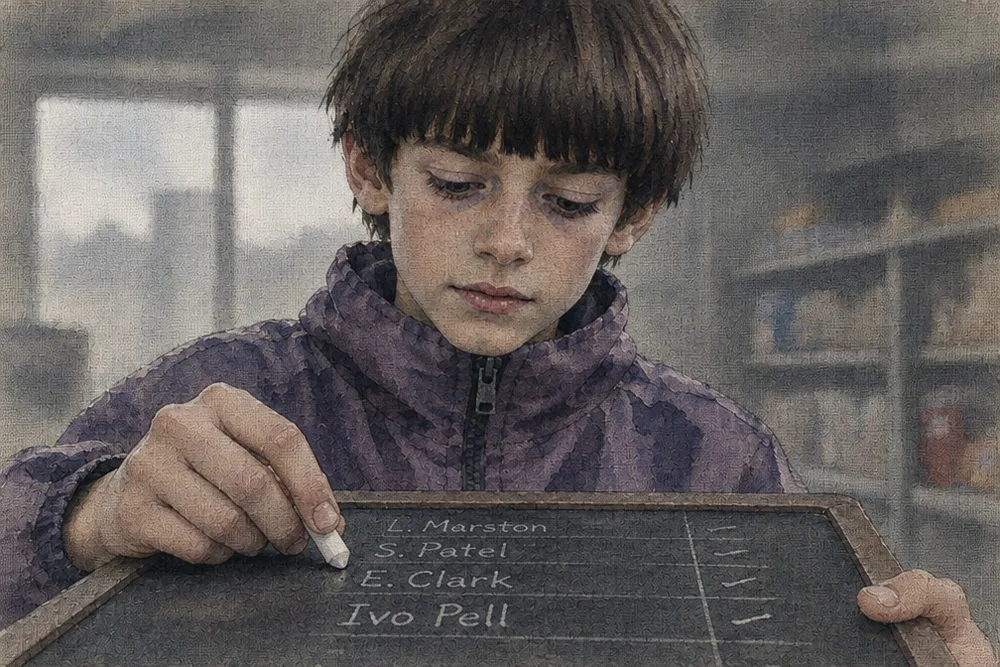
“Good. Leave the mark as it is.”
He put the chalk down, satisfied. Mahé saw how carefully he watched the others: not merely the total, but the spaces between them. She had taught him that counting was a tool, not a substitute for noticing. It pleased her that he was using it both ways.
Sabine came over with the folded chart. “The marks held,” she said. “The wall tops stayed above the water while we were on them. I wouldn’t take a class over that last stretch again at the same height.”
“Can the children use that route again?”
“Not without checking it first. The wall gap has changed. We should not treat it as a road.” Sabine’s mouth tightened at the last word. “It got them here.”
Mahé looked at the damp paper. The pencil marks had smudged at the folds, but several turns and ledges remained clear. The chart had been made in a hurry and used exactly as it was needed. It had not made the day harmless. It had given the children something to follow.
“You brought us to the landing,” Mahé said.
“Étienne knew the walls. I could mark the turns.”
“And you did.” Mahé handed the chart back.