Subtract Five Hours, Add Oyster Walls
Page 147 of 259
Chapters
Sabine rolled her chart closed. “I’ll take the inspection back to the board.”
“Take the fittings too. They’re evidence, and they’re useful.”
“Both?”
“If the board wants proof, they can look at the rust. If they want a berth, they can pay for the missing pieces.”
Sabine’s eyes rose to hers, hooded and intent. “You’ll have to tell them the reserve boat may be the only option until then.”
“I already told them. Now I can tell them why the old float isn’t an option.”
They took the trolley to the board’s temporary office in the basin shed. It smelled of wet coats, engine oil, and the tea someone had forgotten on a radiator. A plan of the island and its shore lay spread across a folding table, held down at the corners by a mug, a spanner, and a coil of light line. Nessa set the salvaged cleat in the middle of the map. Its green metal left a damp crescent on the paper.
Three board members turned from the window. The oldest one looked past the fittings to the estimate in Sabine’s hand. “Is the float usable?” he asked.
“No,” Nessa said.
“Not with repairs?”
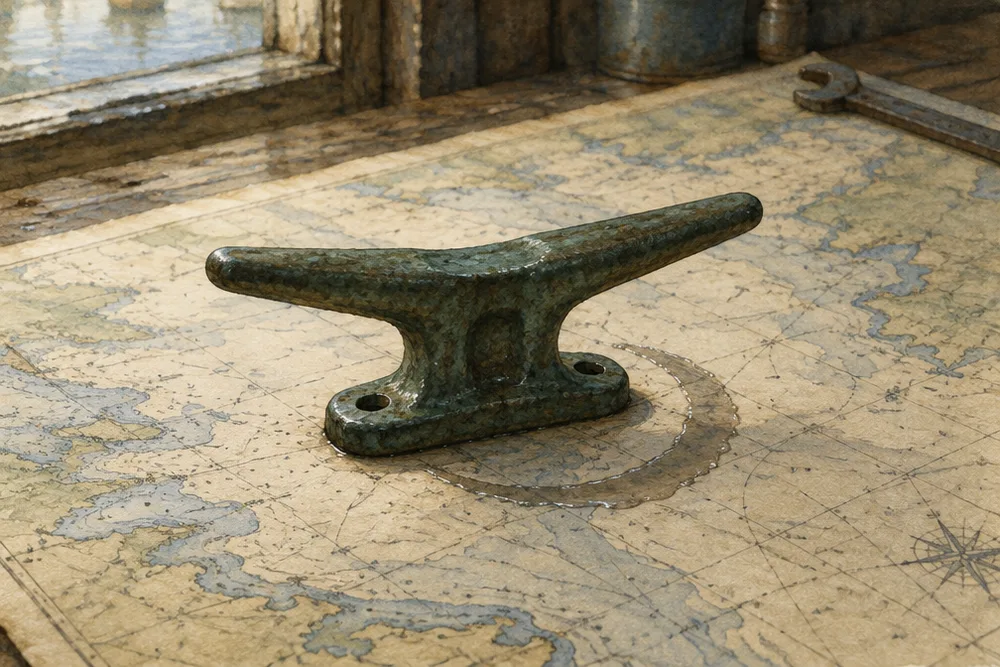
“Not as a passenger berth. The shell is rotted through in several places. A load test opened it. I removed the fittings that were sound.” She touched the cleat. “This can go on the new one. The hull cannot.”
The board member picked up the cleat and tested its weight. “The old float was offered at no cost.”
“The cost was in pretending it could carry people.” Nessa kept her boots planted wide. “You asked me to say whether it was safe. It isn’t.”
A woman from the funding office scanned Sabine’s notes. “The new-float estimate is still above the allocation.”
“Then it needs a revised design,” Nessa said. “Smaller platform, fewer extras, same safe approach. No false economy in the hull or the ramp.”
“And what does that do to the trial schedule?”
“It may push the trial back. We build, inspect, and test before anyone boards. If that means the trial moves, it moves.”
The room went quiet. Outside, a forklift beeped twice and stopped. Nessa could feel the old reflex to soften the answer, to offer an alternative before anyone asked. She did not. A service was not a favor she could make good by stretching herself past what the equipment allowed.
Sabine laid her report on the table. The notes were compact, the failed load levels marked with arrows and measurements. “I can revise the site drawings as soon as you confirm the smaller float’s dimensions,” she said.