Subtract Five Hours, Add Oyster Walls
Page 125 of 259
Chapters
Sabine had drawn the turn as a generous arc. Mrs. Pell’s front wheels met the inside edge of it and halted against the trestle leg. She backed a handspan, turned the chair, and tried again. This time the wheels cleared, but the left rim struck the workshop door where it leaned at an angle. The impact made the door shiver on its supports.
“Stop,” Nessa said, already stepping forward. Mrs. Pell had stopped herself. She kept her hands on the rims and studied the arrangement with a frown.
“The door’s standing in for the store wall?” she asked.
“More or less,” Sabine said.
“Then I can’t make the turn.”
Sabine crouched beside the chair and looked along the path from Mrs. Pell’s eye level. From there, the width that had seemed sufficient collapsed into a funnel. The wall projected farther than the baseboard. The store step occupied the inside edge; a pile of return crates occupied the outside. To negotiate it, a chair had to reverse into the gangway, where a person might still be stepping down from the boat. Two people meeting would have no way to pass.
“We could cut the store step back,” Sabine said, hearing how quickly she had reached for the building instead of the drawing. “That gives us another—”
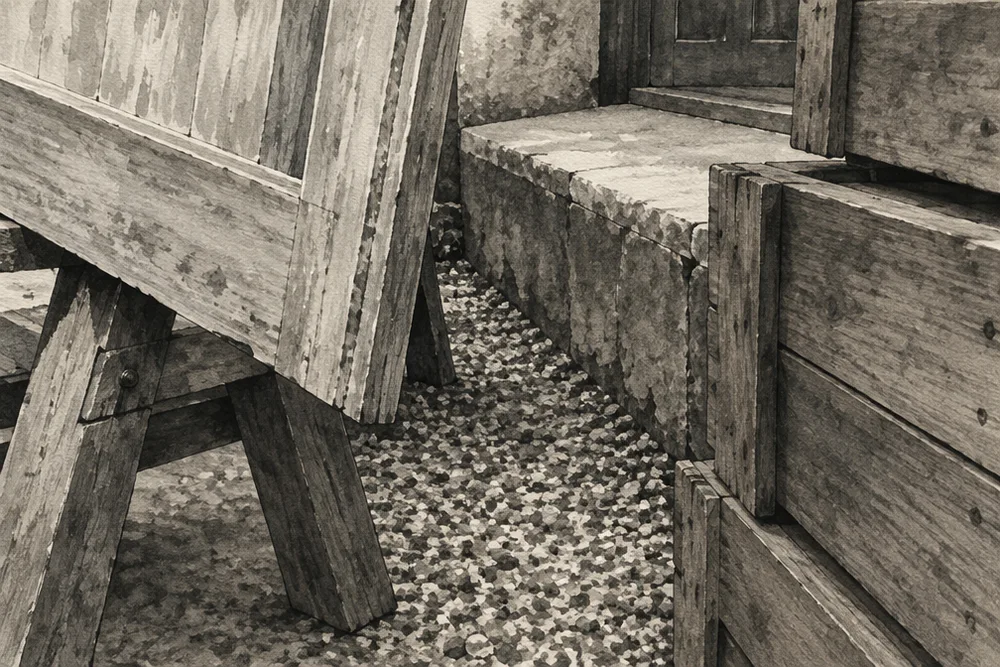
“The step carries the wall,” Mahé said. She touched the timber with her short fingers. “And the store is full.”
Nessa pulled the chair back from the mock passage without touching Mrs. Pell, who had already started reversing it. “If I come alongside and she’s on the float, where does she wait while the next person gets off? This isn’t only a ramp. It’s a route with people arriving at different speeds.”
The chair cleared the turn only after Mrs. Pell backed to the chalk line, made a broad three-point manoeuvre, then pushed through with one wheel briefly riding the gravel’s uneven edge. She stopped at the far end without looking up.
“I can do that when I have space and time,” she said. “I can’t do it when there are people behind me and freight coming round.”
Sabine stood. She had drawn the passage from measurements taken against empty ground, then trusted the clean line of it because the line was hers. The new numbers would not be an adjustment to the curve. They changed the whole approach. The store was not a corner to get around; it was the obstacle every person would meet at the island end.
“We need to use the bay,” Mahé said quietly.