Subtract Five Hours, Add Oyster Walls
Page 117 of 259
Chapters
Mahé pointed toward the store’s side wall. “The delivery bay is behind that corner. It doesn’t get used for passengers because the steps come down in front of it.”
“It might be the space we need,” Sabine said.
Nessa measured the corner with her eyes, imagining a passage from the landing that did not force a chair to make the same turn the door had failed to negotiate. “Might,” she said. “We’ll need more room than this.”
They found the carpenter beside the store steps, putting the door back on its trestles. He had been asked to make a second version with a handrail, but Nessa stopped him before he started cutting timber.
“Not yet,” she said. “A rail won’t fix the turn.”
“I can widen the mock-up,” he said.
“The mock-up’s wide enough. The shore isn’t.”
Mahé led them around the store to the delivery bay. It was a deep recess beneath a low roof, intended for crates to be unloaded out of the rain. One end was blocked by a cupboard and a pile of broken shelving. The bay’s outer edge opened toward the old landing, but the route was obstructed by the store’s corner and a raised stone sill. There was room for a person to stand and wait. There was not yet room to turn a chair.
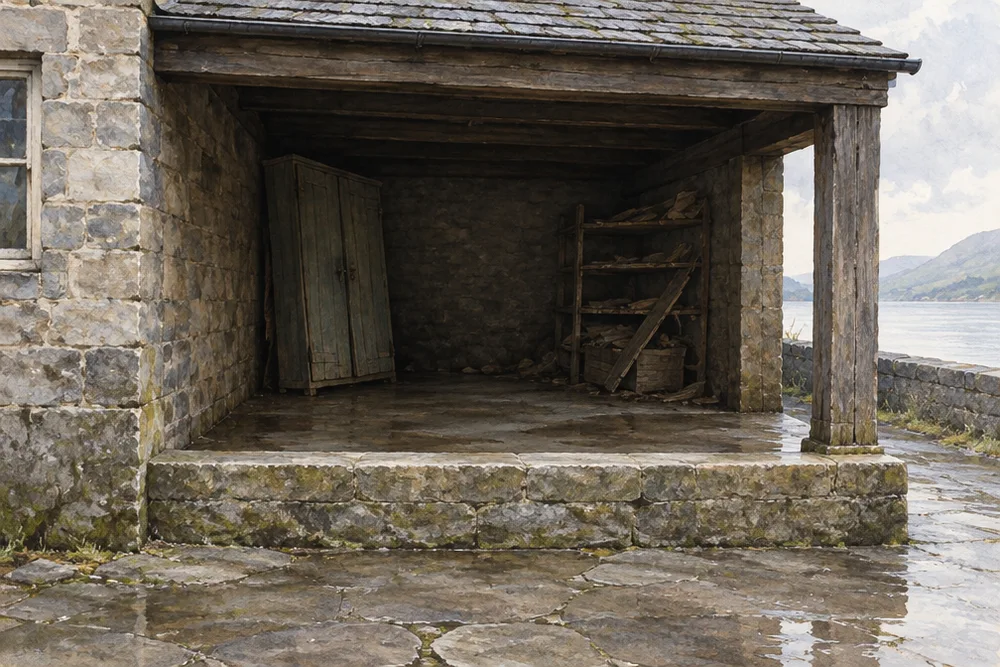
The carpenter bent to inspect the sill. “Take that up, shift the cupboard, and we could open the bay straight through.”
“The cupboard belongs to the school,” Mahé said. “It holds the spare books and the winter boots.”
“Then it needs another home.”
The certainty with which he said it made Nessa glance at the cupboard, a low, painted thing with a warped door. The contents mattered more than the wood. Winter boots mattered. School books mattered. Any plan that moved them without deciding where they would go was only a plan to make someone else’s problem.
“What’s behind the wall?” Sabine asked.
“The store room,” Mahé said. “Dry goods, mostly. There’s a partition at the back. The bay was made when the store had fewer deliveries.”
Nessa crossed the threshold. The air smelled of damp timber, onions, and old rope. A narrow aisle led past the cupboard toward shelves stacked with tins. The room was not large, but the wall at its far end was thin board rather than stone. A passage through it might open into a second storage space—or into the place where the store kept the things it could not lose.