Seven Minutes Under the Glass Dam
Page 158 of 191
Chapters
“The crews checked twice.”
“Then we have to decide where the water goes.” Inez had followed them up from the landing, the inspection mirror now back in its case. Her face was set, but her eyes kept returning to the rising channel.
Ayo followed her gaze. Beyond the edge of the town, on the landward side, lay the salt pan: broad, flat, and pale even under storm clouds. Its shallow beds were divided by low embankments. In dry weather, the tenants harvested salt there, working the beds in the long bright hours. A spillway connected the pan to the low ground, but its gate remained shut.
“If we open the spillway, the pan takes the surge,” Ayo said. “It was checked as temporary storage.”
“Checked isn’t consent,” Inez said.
Ayo looked at her. There was no sharpness in the correction, only insistence. “No. It isn’t.”
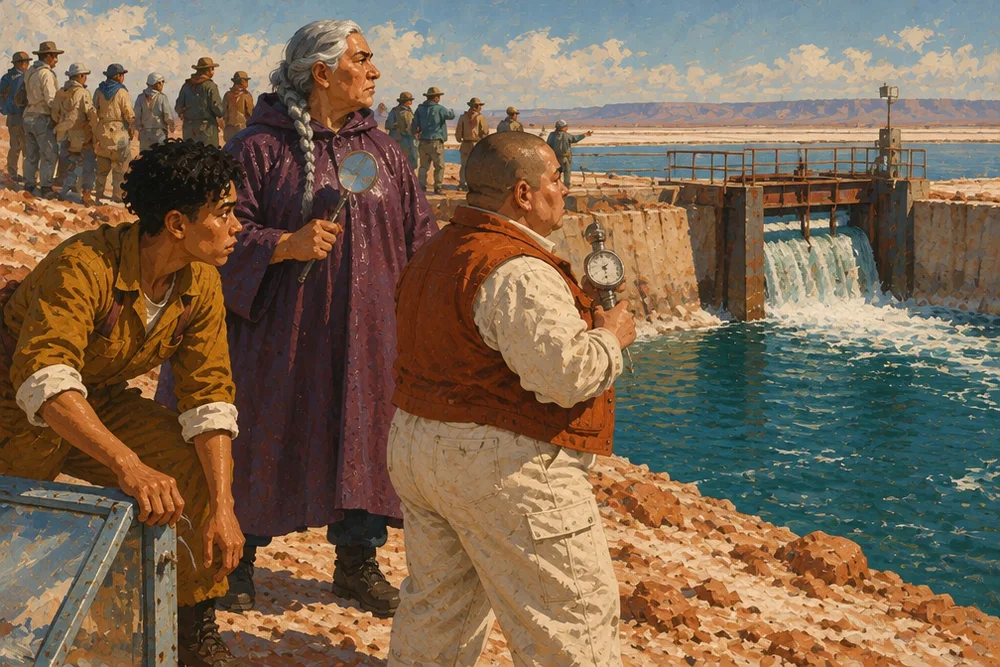
The tenants were gathering at the embankment now, a cluster of figures in waterproof coats. They had seen the water creeping along the path and understood why the town had called them. No one had yet opened the spillway. The gate lever was on the embankment, behind a waist-high barrier. A sign listed the salt beds and the people who held rights to them.
Ayo read the names because she wanted to know whose work was at stake. She knew some from the inspection visit: families with small houses on the quay and drying racks beside the pan, workers who had been asked before whether they would accept water across their beds. They had refused an uncompensated diversion then.
The surge rolled through the open barrier behind them. Far off, the glass gate gave a hollow boom. No one turned toward it. They were all watching the tenants, who had not yet said yes.
The tenants’ spokesperson, a woman with a rust-colored scarf tied over her hair, stepped to the front. “How much water?” she asked.
Ayo could not tell her. She could describe the rising level, the damaged guide, the open gate, and the houses that had been emptied. She could not calculate how long the surge would last or how deep the pan would fill. The available readings were still inside the barrier, and the instruments there were not meant to predict a storm behaving like this.
“Enough to flood the beds,” Ayo said. “Possibly the work sheds. The low quarter is empty, but the homes will take water if the surge keeps coming.”