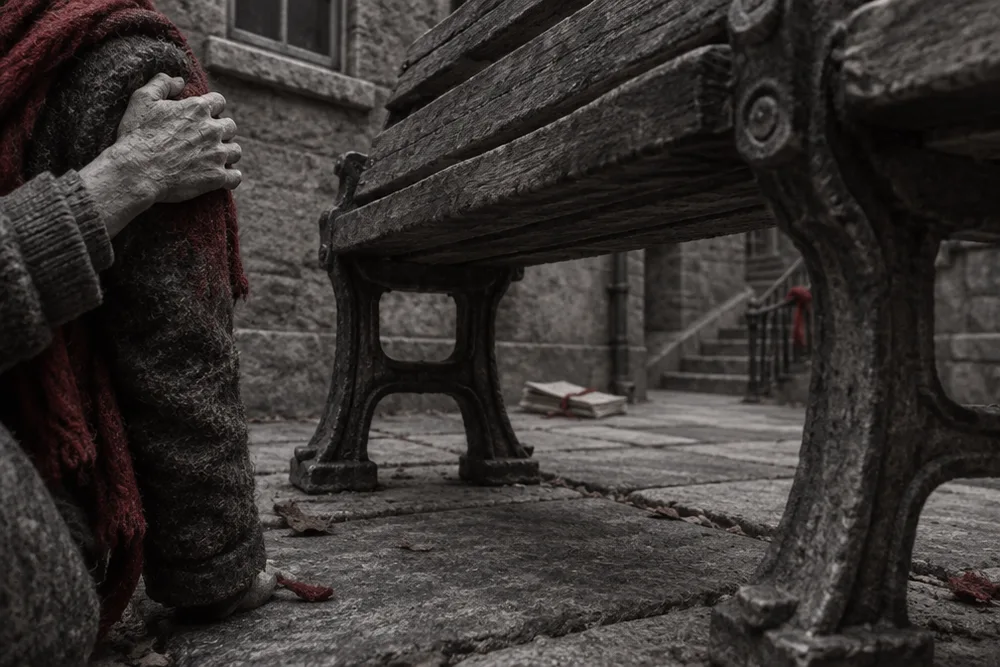
Put the Empty Chair on the Plan
Page 100 of 271
Chapters
“That isn’t carrying it to a meeting,” said the woman holding the lower corner. She was already breathing hard. “That’s building a new way in for a bench.”
They backed it down in careful inches. Yarrow’s shoulder burned by the time all four legs stood on the pavement again. A patch of plaster dust streaked one tenant’s sleeve. Merrit marked the stair width in his notebook and looked up at the window, measuring with his eyes as if the room might become accessible by being observed accurately.
“The hall’s worse,” he said. “You’ve got a step at the door and the floor falls toward the stove.”
“The door has a ramp board,” Yarrow said. “And the floor falls toward the drain. It’s supposed to.”
“I know what it’s supposed to do.” Merrit’s voice was patient, but his jaw worked as he put the tape away. “This room has a level floor. Once the lift’s in, it’ll be easier for everybody.”
The lift was not on the council sheet. Yarrow had heard only that Merrit was willing to price alterations if the upstairs room could stand in for Sill Hall. The town needed a place guaranteed before it released the covenant; she had endorsed the replacement on the assumption that a suitable room existed. Now the bench lay on the pavement between them, still dusty from a journey it could not finish.
“What sort of lift?” Yarrow asked.
“Platform. External shaft, likely. I’d need an engineer to sign off. It won’t be cheap.” Merrit looked at the tenants rather than at her. “But if there’s a commitment to use this room, I can get a proper estimate.”
One of the tenants, a narrow-faced man in a patched oilskin, had been quiet through the measurements. He tapped the bench with his shoe. “You can put the lift in. What happens when it’s out of order?”
“We arrange access another way,” Merrit said.
“Where?”
Merrit stopped with the tape halfway into its case. He stooped toward the speaker, the way he did when a voice came from below him. “I can’t promise a second room. I can promise a repair schedule.”
A woman from the lowest doors joined them, carrying a folded notice from the council. She could not climb the stairs; she had not tried. She took the bench’s end as a table and unfolded the notice over it. “Then put this down. I’m not asking anybody to carry me. I’m asking you to write that the room is no use to me without that machine, and no use on the days it fails.” She smoothed the paper with a palm. “I can tell them what to write. I can’t sit in the room while they write it.”