Please Hold for the Ferry
Page 93 of 211
Chapters
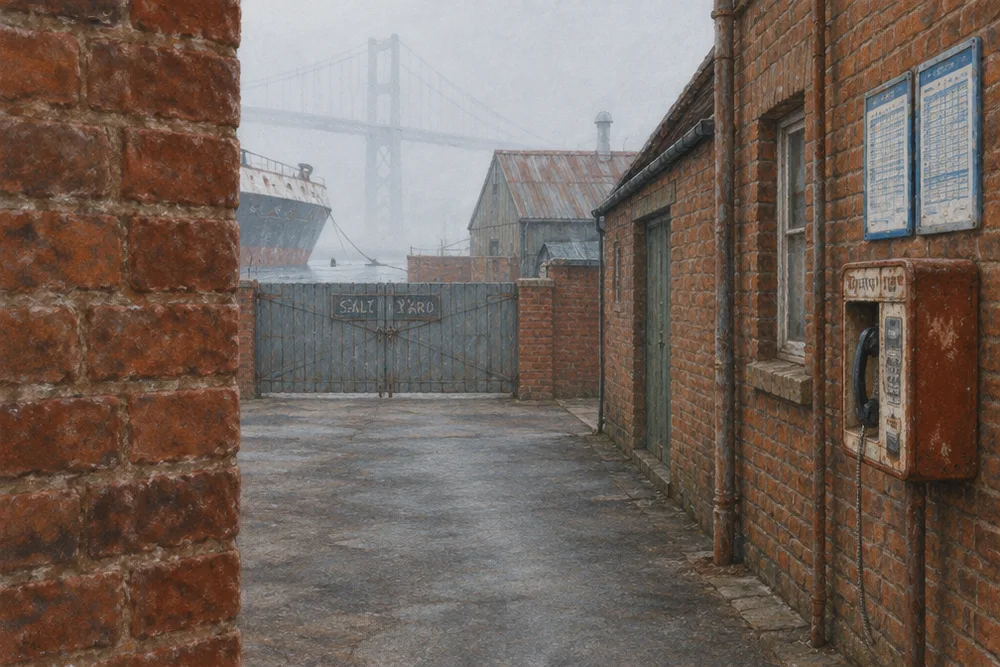
“We’ll look,” Sima said. “No claim beyond that.”
The laundry workers had to return. Leon checked that the group had its break passes, then took the names of two who could come to a later walk. He did not ask them to commit to a stop, only to a time when they could see the place. Etta said she would try if her shift allowed it. Harl said the uphill walk remained a problem. Leon wrote both down, leaving space between their names.
Cora picked up the chalk. The proposed turning arc was incomplete, broken by footprints and damp grit. She put the chalk into Sima’s hand rather than pocketing it for the office. “You’ll want this if we go to the yard.”
Sima took it. “And I’ll need the gate measurements.”
“We can find those out.”
Leon started toward the lower road. He carried the lunch sack under his arm and walked with his shoulders bowed under the low brick arch. Cora followed him, then Sima, with the clear map sleeve held above the wet chalk.
They passed the hospital’s service wall and reached a bend where the old brickmaking yards opened toward the channel. From here the ferry slip was hidden by warehouse roofs. The upstream road bridge showed only as a dark bar through mist, busy with traffic that could not be heard over the wind off the water.
Leon pointed to a narrow service lane. “Laundry carts come out there when the hospital entrance is jammed. The van waits beside the salt wall, then backs to the apron.”
“A shuttle can’t back in among loading vehicles,” Sima said. She checked the map rather than dismissing the place. “But if the apron is wide enough, it may be able to turn. We’d need to see the truck schedule, the gate, the pedestrian path, all of it.”
“And how far from here?” Cora asked.
“Far enough that Mina may be right,” Leon said. “We’ll measure it, not guess.”
Sima lifted her head. “A workable stop can still be a bad stop for some riders. If Salt Yard is the only safe option, that has to be visible in the record.”
Cora thought of the report’s clean zero, a number that had left no space for the way messages had come in, or for riders who could not reach the proposed route. She had helped the zero survive by not asking how it was made. Now the group had taken the trouble to show them a place that might work, while naming who might be left out.