Please Hold for the Ferry
Page 79 of 211
Chapters
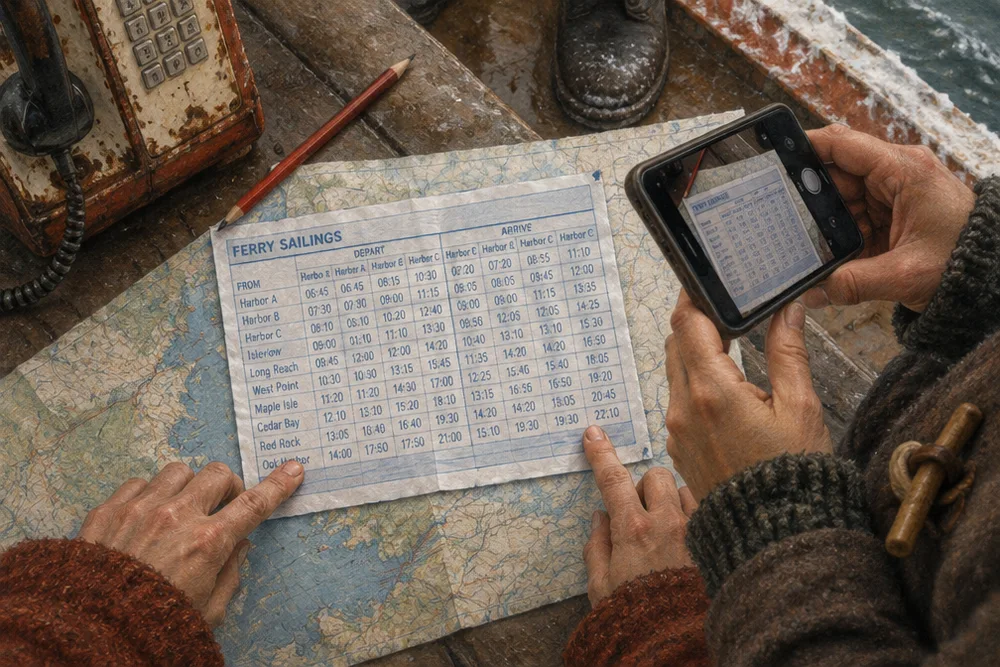
When she put the handset down, Sima was looking at the steel drawer beneath the counter. “Have you got a copy of what they were using?”
Cora pulled the drawer until it caught, lifted it by the handle and pulled again. The timetables inside had bowed around a packet of spare ticket rolls. She drew one out by its folded edge.
Sima read down past the sailing columns. “It doesn’t say what the number’s for.”
“It didn’t have to, when we printed it. If the boat was late, you called. If you left your gloves on it, you called.” Cora put a finger beside the number. “When Leon asked where to suggest a stop, I pointed right there.”
Sima looked up. “You remember doing that?”
“I remember doing it without looking at him. I was trying to get the queue down the steps.” She took her finger off the sheet. The number was in smaller type than the fares.
Sima took out her phone. “Can I get a picture for the correction?”
Cora laid the timetable over the map and pressed its corners with two fingers. Sima moved in close enough that the number filled the screen, then backed up until the sailing columns came into view.
“I’ll say eleven requests were received on the dispatch line and identified after publication.”
Cora looked at the timetable instead of at Sima. “Could you put the dates in? Not the dates people called. When the survey closed and when we checked the box.”
“So they can see which happened first.”
“So they don’t think people started calling because they saw the route.”
Sima lowered the phone and wrote that down. Cora had expected to have to argue it. She watched Sima leave a space between the two dates on the page, enough room to put the wording in later.
“Keep this one,” Cora said, nudging the timetable toward her. Then she drew a second copy from the drawer for herself. At the Weigh House she could ask what an operator’s estimate actually looked like. She’d written the word down as though it were something she could go and fetch, but she didn’t yet know what a driver would have to see, or what the clerk could take across that counter.
She slipped the timetable into her notebook with the contact line showing and went out.
At the Weigh House, the public counter stood under a row of high windows filmed with road dust. The clerk had a stack of renewal forms squared beside the ledger. Behind the wall, board members spoke in low voices over the scrape of chairs.