Please Hold for the Ferry
Page 106 of 211
Chapters
“No one asked you to,” said Sima. “We’re testing the timing against the bridge slot.” Venn looked at the sheet. “The timing assumes you get that slot.” Cora looked from one to the other. The plan’s tidy seven minutes had made the river crossing sound like a door that opened whenever they reached it. On the shuttle schedule, the bridge slot was a narrow gap between other traffic. Miss it, and the next opening belonged to someone else.
“Then we count the miss,” Cora said. She wrote the bridge time in the margin, leaving room beside it for the actual time. “And we don’t make the riders run to rescue our estimate.”
At Salt Yard, the gate crew had moved the pedestrian barrier inward for the test. Fresh pale marks showed where its old swing had scraped the pavement. Beyond it, the turning apron opened between stacked salt bins and the depot’s brick wall. A chalk arc curved across the concrete, the route the shuttle’s rear wheels were meant to follow.
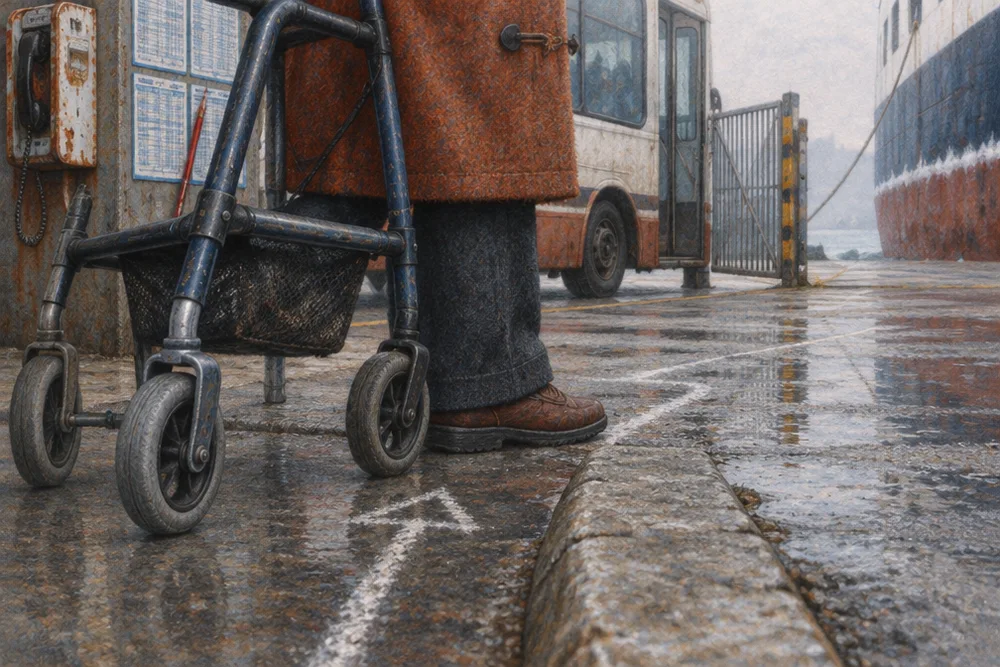
The shopping-bag rider, Mrs. Eames, arrived first, wearing a green headscarf and a coat buttoned to the throat. She set her bags down only long enough to rub the red dents from her fingers. The man with the frame came with his neighbor, who held the folded frame while he climbed the curb. Cora started to step toward them. He raised one hand. “Let me find the edge.” She stopped where she was.
Leon came from the hospital side with three laundry workers. His white vinyl jacket shone in the flat daylight; his waxed lunch sack was tucked beneath one arm. “We’ve got the break change,” he said. “Not the whole shift. The ones who can get away.” He introduced each person by name and let them say what time they needed to reach the hospital entrance.
Sima checked the chalk and then the watch. Venn’s driver brought the shuttle around the depot, steering slowly. Its tires passed close to the chalk arc. Mrs. Eames lifted her bags again and watched the bus’s front swing into the yard. Cora stood beside the gate, hands empty, resisting the urge to direct everybody into a convenient line. The queue would have to be made from where people actually waited.
The first attempt looked easy until the bus stopped. Mrs. Eames climbed aboard with one bag in each hand, set them down, then turned to pull the second one clear of the doorway. Venn’s driver waited without sounding the horn. The man with the walking frame came next. He opened it, tested the curb, and took the step sideways, one hand on the rail.