Please Hold for the Ferry
Page 101 of 211
Chapters
“No,” Sima replied. She did not turn away from him. “But it can keep the people it misses from disappearing into a successful total.”
Cora looked at Leon. He had not come to give them a flattering version of the stop. He had brought the shift gaps, and now he was naming the distance. She was glad he did not leave the harder part for her to explain later.
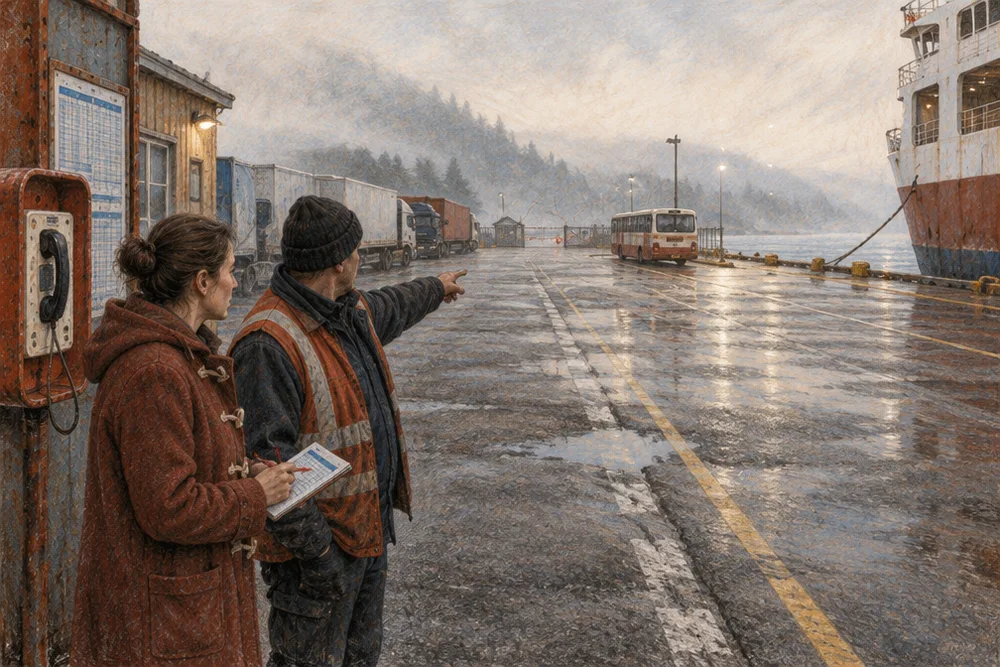
The supervisor took them through the rest of the yard, stopping at the edge of the marked apron. He showed where the trucks emerged, where the delivery door had to stay clear, and where workers crossed to the sheds. Each route pressed against the neat bus path Sima had drawn.
Cora asked whether the bus could wait outside the fence if the yard were busy. The supervisor said a shuttle could not block the road entrance. Sima suggested a marked lay-by, then crossed it out when she saw the angle required for a full-size vehicle to enter and leave.
“There’s space for the bus to stand here between the truck batches,” the supervisor said at last, pointing to the inside edge of the apron. “But only if nobody treats the space as storage. And only if the gate is not the entrance.”
“Separate opening,” Sima said.
“Separate opening, cleared waiting area, no boarding during a truck movement.” He paused. “And I need the driver to call the depot before entering. If our batch is moving, the bus holds outside until it clears.”
“That could put the bus behind schedule,” Cora said.
“It could put a truck behind schedule if you don’t.” The supervisor’s tone stayed level. “I’m telling you the condition, not negotiating it.”
Sima wrote the condition in the margin. “We’d need the operator to assess the delay and include recovery time.”
Cora recognized the old trap: a plan that worked only when nobody was late, nobody needed extra boarding time, and nobody had to obey a rule written for another part of the system. She did not know yet whether the drivers could absorb the delay. She knew it had to be asked in those terms.
They stopped beside the inward-swinging gate again. The supervisor pulled it shut and showed them how its bottom dragged across the concrete. Moving it would mean more than shifting the hinges. The crew would have to cut a new opening, secure the fence edge, set the gate clear of the approach, and mark a waiting space that did not intrude on vehicles.
“How long?” Sima asked.