Mussel Boats at the Upstairs Landing
Page 41 of 245
Chapters
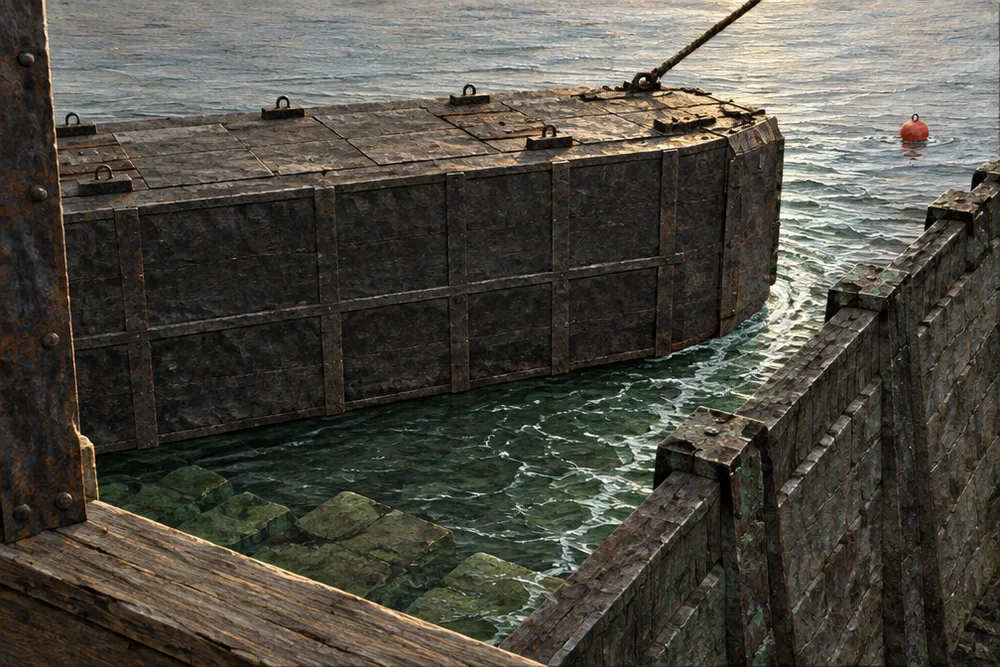
Nera saw the open water beyond, then the gap closing. The outside cut was the only route that admitted the loaded mussel boats. The inside shortcut bent between drowned walls and crossed a shallow stone sill; Tomas had said it was unsafe under any substantial load.
“They know the boats are up there?” she asked.
“The harbor crew knows the channel is used. They think the boats can wait until the test is finished.”
“Six families don’t have another landing.”
Tomas glanced at her. “I know.”
The caisson shifted again, its end dragging through a comb of water. The survey float snapped free of the snag and swung wildly. For a moment the narrow channel looked open. Then the timber frame slid across the cut until only a dark ribbon remained between it and the nearest wall.
Nera grabbed the doorpost and leaned farther out. From this angle she could see the caisson’s rough planks rising above the tide, the iron braces dark with water. It had been built to test a wall that would soon span the same route. At its current angle, it blocked the cut more effectively than any wall plan she had seen.
“Could a loaded boat squeeze through there?” she asked.
“Not with the turn on the inside. A narrow hull might, light. A mussel boat with a full hold would ride low and be pushed sideways.”
“What about a line from the tower?”
“To what? The caisson? It’s being towed.”
Nera’s fingers tightened on the post. She could already picture a hull driven broadside into the old stonework, a crew scrambling over slick planks while the tide rose around their ankles. The upper rooms were a landing because the lower ones had vanished. The people who used them had worked out how to live with the tide, even if the village had preferred to call the quarter empty.
Behind her, somewhere above, the bell shifted in its cradle with a faint, deep vibration. The sound was so slight she almost mistook it for the tower settling.
Tomas turned at once. “Did you touch it?”
“No.”
A gust pushed through the open room. The old rope tied to the bell crown stirred. The bronze remained still, but its cradle gave a dry creak.
“The beam’s holding,” Nera said, mostly to herself.
“For now.”
She went to the opening and looked out again. The workboat’s engine had fallen quiet. Its crew were hauling the towline by hand, trying to swing the caisson into line with the outer works. The channel’s remaining gap flashed green and narrowed beneath the frame. Even from here, she could see the current pressing against the caisson’s planks, finding every seam and brace.