Mussel Boats at the Upstairs Landing
Page 29 of 245
Chapters
“The survey stakes run across the old cut. They’ll make a basin behind them, and a wall where the outside lane bends. The drawing leaves no proper passage.”
“Then tell them that too.”
He had said he would testify that traffic continued. He had not promised to explain what the wall would do to it. But he could already hear the questions in the shed: how many boats, how often, how many households depended on them? He could answer only from memory, and memory was not a count.
“I’m not the one who knows the crews,” he said.
“Iven does.”
“Then let him speak.”
“He’ll be there if he can get the boats out.”
They reached the shed. Mera Vennick stood just inside the door, tall and erect in an indigo shawl, her gray coils pinned high. She had a stack of folded papers in one hand and a pencil behind her ear. Her face, with its pointed chin and small gap between her incisors, softened when she saw Nera, then became wary at the sight of Tomas’s wet coat and the board tucked under his arm.
“You found the marker?” she asked.
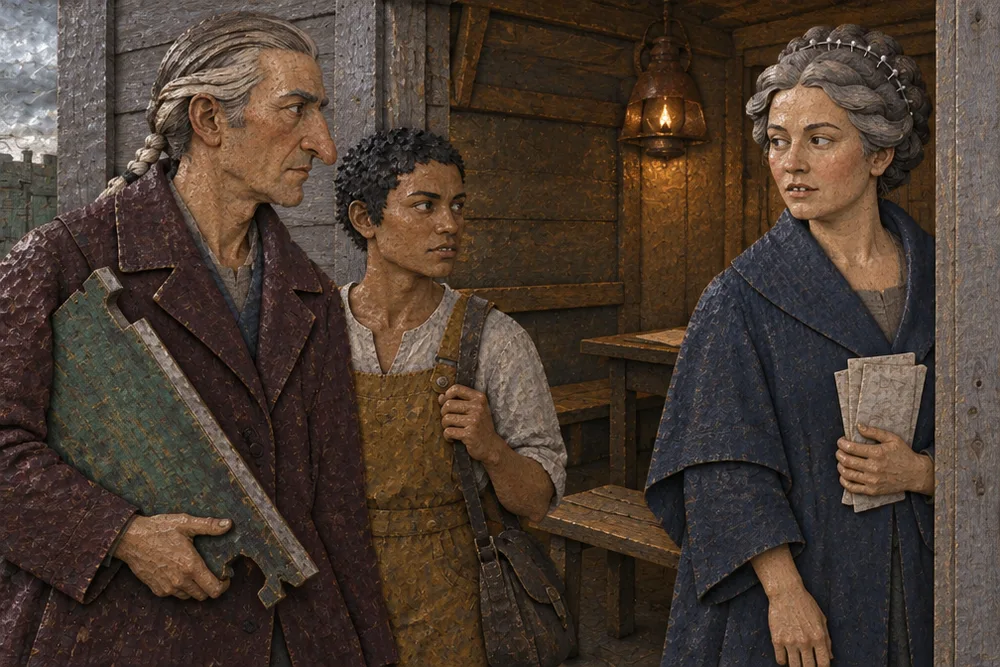
“We found it under the survey float,” Nera said.
Mera’s gaze rested on the warped wood. “A channel marker.”
“His,” Nera said.
Tomas met Mera’s eyes. She had been a bell keeper long enough to recognize the difference between a sound and the silence around it. He wondered whether she, too, had known boats were still using the cut. Her expression revealed nothing.
“I’m going to tell the vote,” he said. “The ferry service ended. The traffic didn’t.”
Mera set the papers on the nearest bench. “Then you should tell them before they mark the ballots.”
The room quieted. A few villagers turned from the tables. Nera shifted her tool bag to the other shoulder. Tomas felt the marker’s rough edge bite into his palm. It was a small object to carry into a room full of arguments, but he had carried less useful things for longer.
“All right,” he said. “I’ll tell them.”
No one had called the meeting to order yet. The shed smelled of damp wool, lamp oil, and the salt that clung to coats brought in from the water. Ballots lay in neat stacks at one end of the tables. At the other, a sketch of the proposed harbor wall was pinned beneath a brass weight. Its penciled line crossed the drowned quarter’s old lane without a break.