Mussel Boats at the Upstairs Landing
Page 224 of 245
Chapters
When he was gone, she returned to the shed. Her own customer’s skiff waited on blocks outside, its gunwale stripped for a new seam. She ran her fingers along the exposed wood and pictured the owner coming back to find the work untouched. Then she looked at the fresh cart marks cutting through the yard. She could not clear the track without closing the only straight route from the landing to the quarry road. She could not leave it open without letting the yard become a passage first and a workshop second. Both facts belonged in the book.
Iven Pell arrived near noon carrying a folded sheet of sailcloth under one arm. His green oilskin was salt-stained at the cuffs, and his russet braid lay over his right shoulder. He set the cloth on Nera’s bench and put a short length of chalk beside it. “We need to talk about the winter crossing,” he said.
Nera wiped her hands on a rag. “You want more hours?” “We need a schedule we can rely on. The crews can’t keep guessing whether the yard will be clear.” He unfolded the sailcloth. A rough chart had been drawn across it in charcoal: the landing, the passage, the slope of Nera’s yard, and the road climbing toward the quarry. Iven had marked the hour of high water and the two daily crossings that worked for the loaded boats.
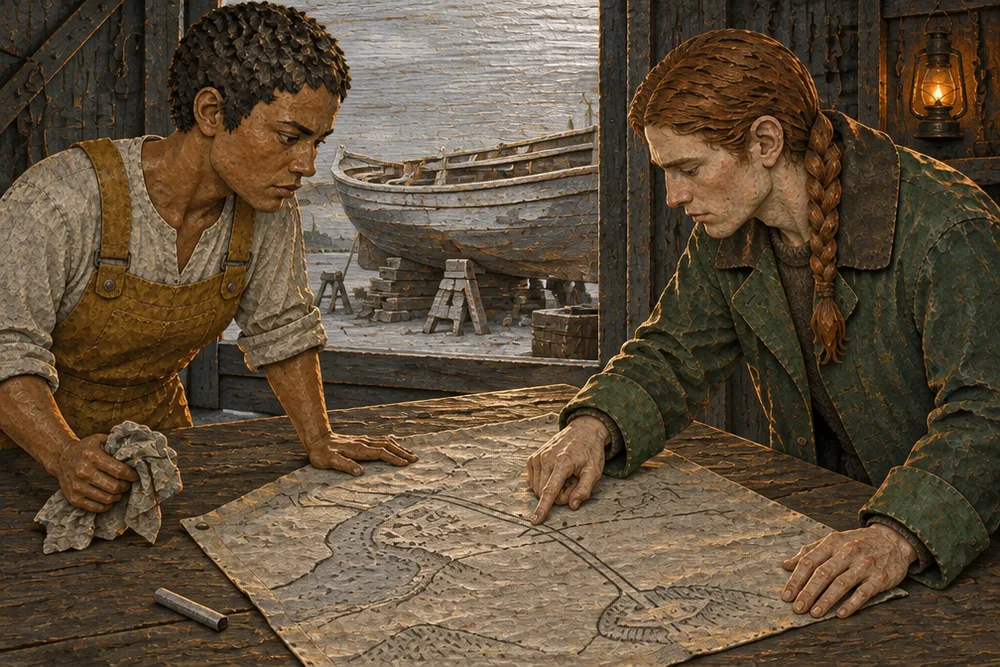
“I can give you the first crossing,” Nera said. “Not every morning. I have repairs.” “The first crossing is the one that matters. If we miss it, we lose the market.” He tapped the chart. “The second is for stores and empty crates. We can run that around your hoist.”
Nera studied the marks. “What happens when a repair runs over?” “The boat waits.” “And when you need the track for two carts at once?” “One waits.” “And if ice closes the shallow edge?” Iven folded his hands. “We wait until the ice breaks.” “That’s not a schedule. That’s a list of ways the schedule fails.”
Iven’s mouth tightened. He had never pretended the arrangement was generous. He had refused temporary charity when the crews were trapped behind the caisson, and he had spoken at the vote because the boats could not reach the open water without the passage. Nera remembered him standing by the slip with a ruined day’s catch laid out on a table. He had not asked the village to feel sorry for him. He had shown them what the closed route cost.