Mussel Boats at the Upstairs Landing
Page 183 of 245
Chapters
Nera watched only long enough to see them get a line around its stern. Then she returned to the yard. The storm had no patience for a single distraction. A boat needed a hand at its bow, a clear passage at its keel, someone ready to brace it when the ground dipped.
“There’s no room for the last two,” one of the crew called.
“Then we make room.” Nera looked at the repair hull on blocks, its ribs exposed, its nose pointed toward the gate. That vessel was supposed to be her next invoice. She ran to its near side and pulled free a stack of shaped planks. They clattered into the dirt. “Shift this one up against the fence. Keep the passage straight.”
The crew hesitated at the unfinished boat. It was Nera’s work, her time and material, and she had already given up the covered bench to weather. She put her shoulder under the hull’s edge anyway. “Now.”
They moved it together, blocks grinding beneath the keel. The space they made was barely wide enough for one more vessel. It was enough.
The boats came in one at a time, with Nera directing each turn. A shallow skiff passed close to the fence. The loaded vessel took the center, where the ground was firmest. The last boat had a cracked rail and a patched sail tied down over its baskets. Its crew asked whether they could leave it under the canvas.
“Not under the canvas,” Nera said. “The pole’s already pulled loose.”
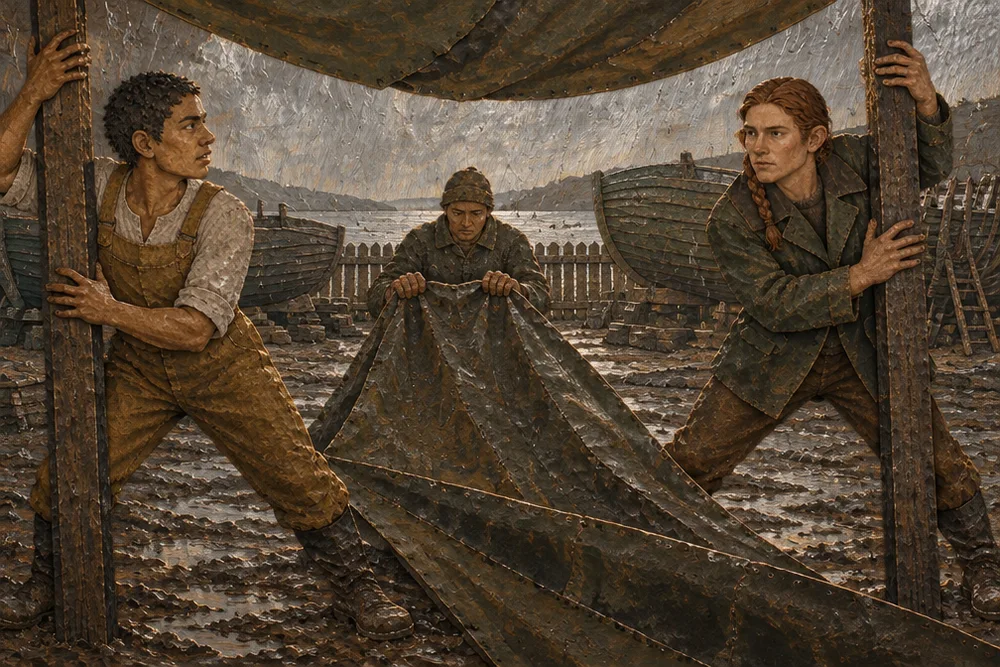
She had one hand on the awning’s support rope as she spoke. The wind had got beneath the canvas and made it drum. A knot slipped on the far side. The whole shelter tilted, its ridgepole jerking toward the yard. Nera dropped the rope and ran to brace the nearest upright. Iven grabbed the other side. They held it between them while the crew unlashed the canvas and dragged it down.
The yard was now a scattering of wet boats, mussel baskets, and loose tools. Rain pattered on bare planks. Nera gathered her chisels and wrapped them in an oilcloth, then shoved the bundle onto a high shelf in the lean-to. Her bench remained outside, its legs sunk into the mud. It had a heavy oak top, scarred by years of cutting, with one end resting on a pair of blocks.
She could carry the small tools. The bench would take several people and a dry hour. The gale had given neither.