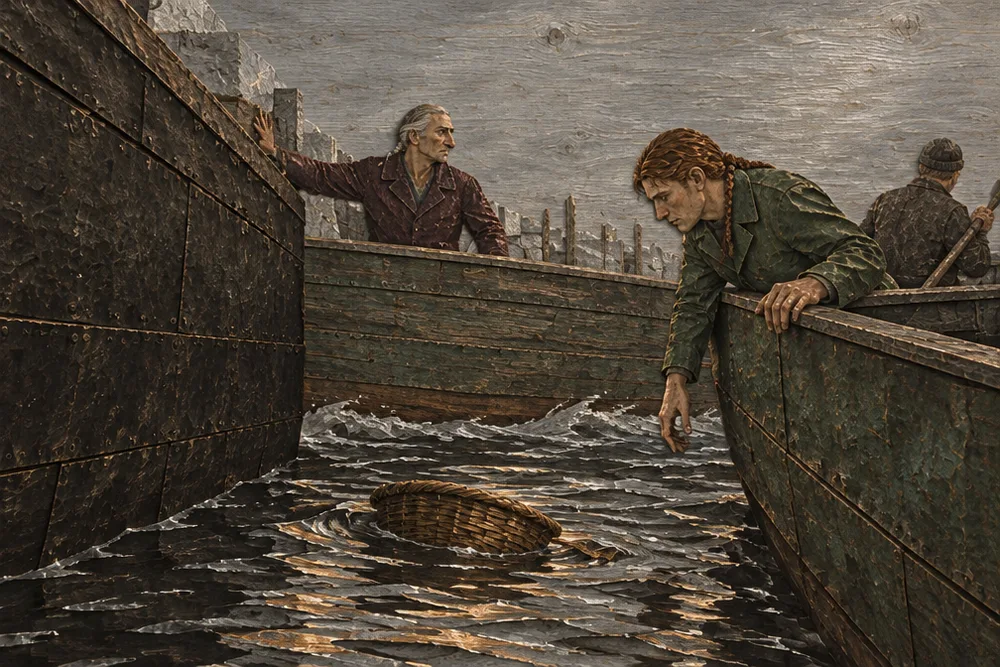
Mussel Boats at the Upstairs Landing
Page 164 of 245
Chapters
“Bring the barge around on my wake,” Tomas told the captain. “No sail. Just the screw. Slow enough to hear me.” He backed his ferry into the open pocket, keeping its stern toward the loaded boats. The barge followed, broad and dark under its cargo of quarry stone. Tomas watched its bow, not the captain. A pale scrape appeared on the stone lip as the poleman pushed too hard. He raised his left hand. The screw slowed. Then he pointed to the farther side of the cut, where the wall fell away under water. There was a deeper channel there, but the old markers had vanished and a stone corner jutted into it like a blunt tooth. Tomas knew the tooth by the way the water wrinkled above it. He had once set a marker there himself: a narrow post with a green cap, driven into a socket cut in the rock. When public ferry service ended, he had pulled the markers and left the posts stacked in a shed. He had told himself there was no point leaving warnings for a route nobody used. The channel was not abandoned, he had learned. It had merely become private, navigated by people who knew its hazards and were not asked to report them. The barge’s stern came close enough to the mussel boat that a basket handle caught against its rail. Iven leaned over and yanked the basket back. One of his crew struck the barge with an oar blade, not hard enough to break it, hard enough to make the captain turn his head. “Stop!” Tomas shouted. He threw his ferry broadside between them. The barge’s crew killed the screw. The little ferry rolled on the wake, its low shoulder dipping until Tomas’s boot slid against the wet boards. A stone block on the barge shifted against its chock with a hollow clunk. “Hold where you are,” Tomas called, and this time the captain obeyed. The boats were still clear of one another. Just. The basket had gone overboard; it bobbed between the hulls, its dark wicker rim turning in the brown water. Tomas looked from the basket to the wall stakes. The proposed line crossed the very water the crews had to use. No drawing on a dry table could show what the turning current did to a loaded hull. He needed the crews to say it in the open, and the builders to hear them.